Skip to main content Skip to search Skip to main navigation

Roland DJ-202 review 2026

The Roland DJ-202 was launched in 2017 as an unusually equipped entry-level controller. Two channels, Serato, large jog wheels and a compact plastic housing were not extraordinary in this class. The integrated TR sequencer with sounds from Roland's classic drum machines and the MIDI output, however, certainly were.

Eight years have passed since our first test. Serato DJ Intro is now called Serato DJ Lite, Roland has updated the firmware several times, and there are numerous newer controllers in the entry-level segment. We have therefore re-examined what the DJ-202 can do today, which features have actually been added and whether the model is still recommended in 2026.

Roland DJ-202: Concept and target audience

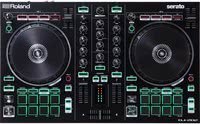
The DJ-202 is a compact, USB-powered controller for two mixer channels and four software decks. It is aimed primarily at beginners, mobile DJs with a manageable setup, and users who want to work with drum patterns and samples in addition to classic mixing.

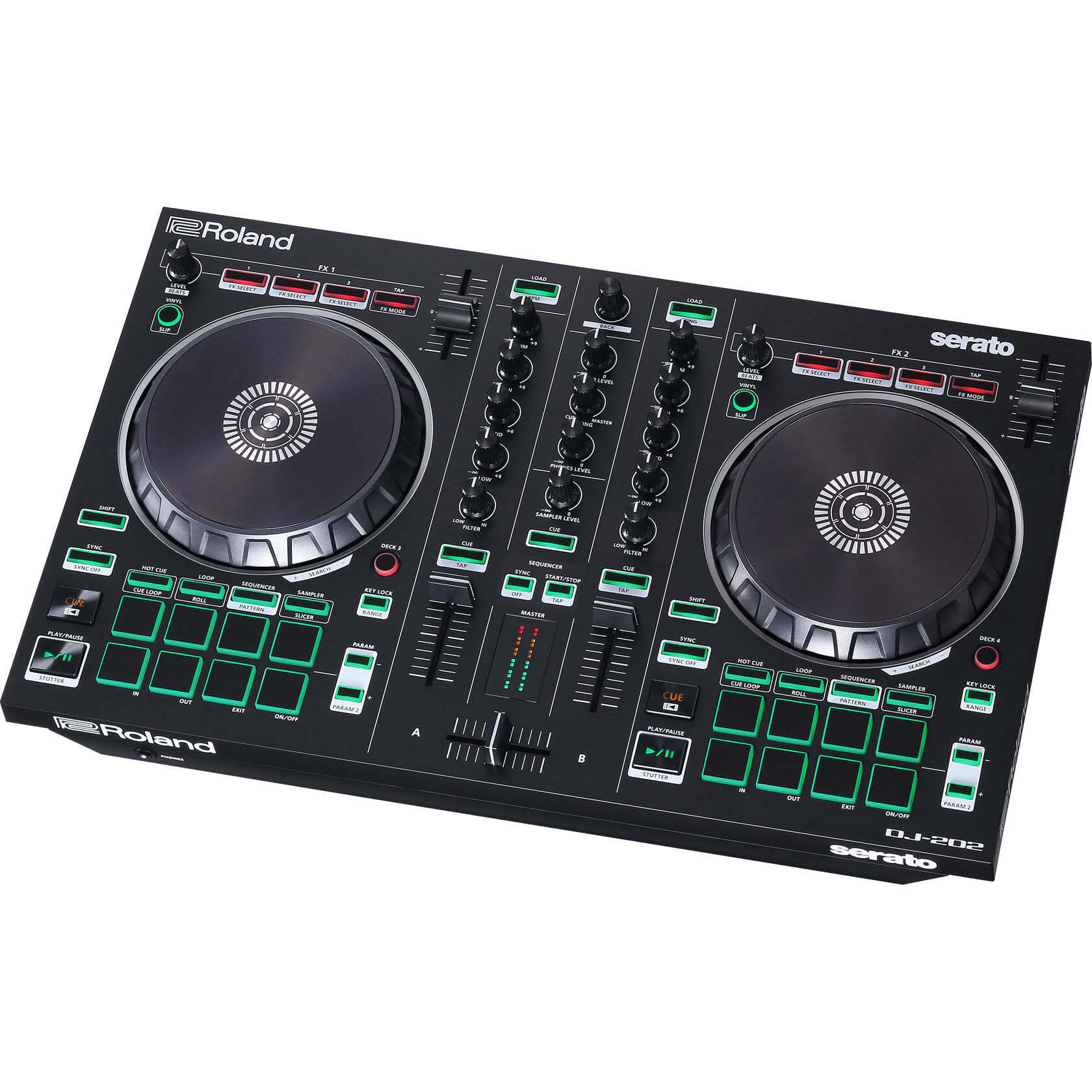
Its dimensions are 47.8 x 29.7 x 6.2 centimetres, and it weighs 2.1 kilograms. This means it fits easily into a suitable controller bag. Nevertheless, there is enough room on the top for jog wheels almost 15 centimetres in size, a total of eight performance pads and a two-channel mixer. The side grips make it easier to transport.

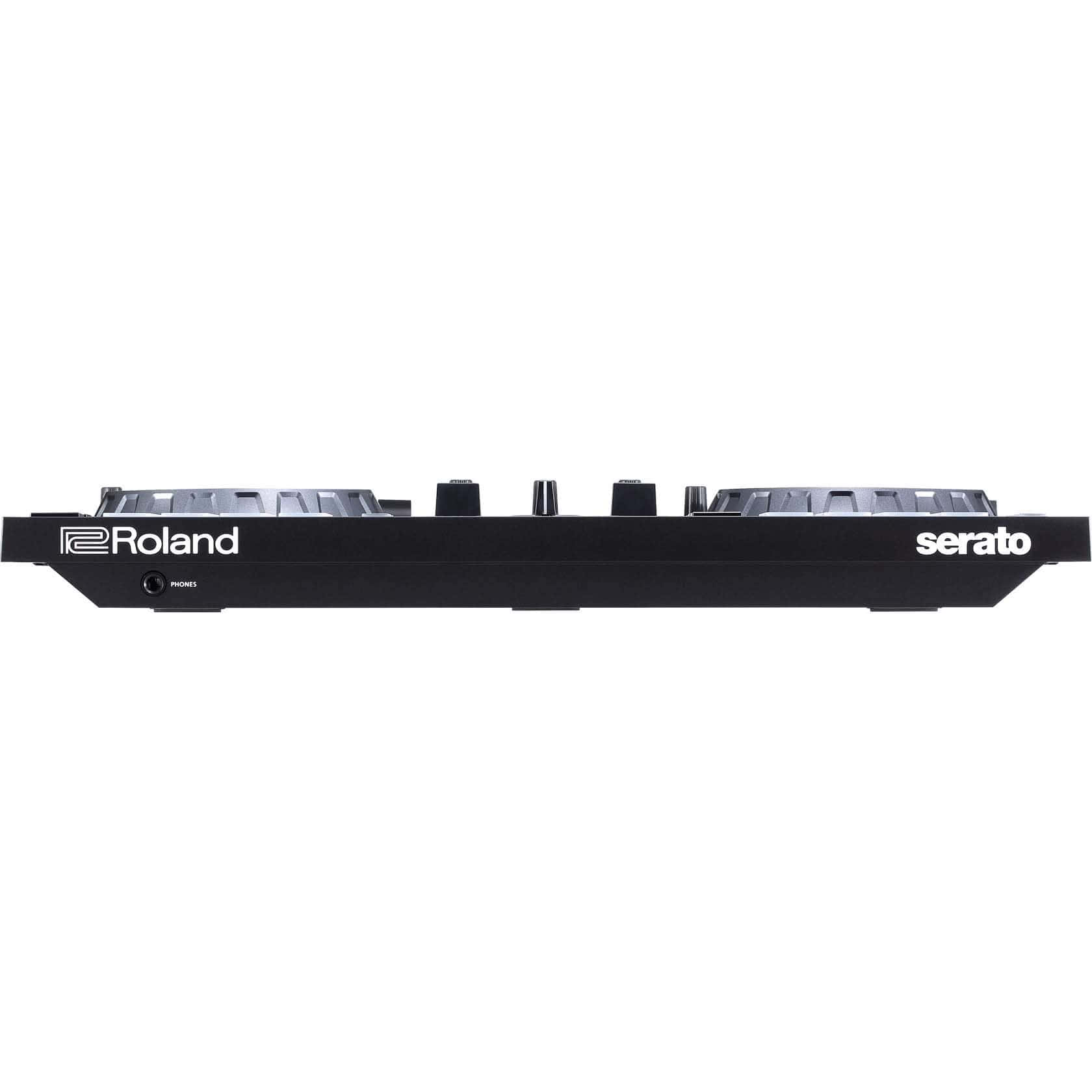
The construction consists mainly of plastic. This saves weight and is appropriate for this price class, but it does not convey the rigidity of a metal housing. The controls are well positioned, the faders run smoothly, and the jog wheels, in particular, make a better impression than the simple housing might initially suggest.

Roland DJ-202 review 2026 - Roland DJ-202: Concept and target audience

Connections and operation

The DJ-202 does not work standalone. Music comes exclusively from the connected computer. External CD players or turntables cannot be fed into the two channels. The USB-B port handles data connection and power supply; a separate power supply unit is not necessary.

The master output is unbalanced via RCA. This is sufficient for active speakers, a home system or small mobile setups. However, balanced outputs are the better solution for long cable runs and professional PA systems. The headphone connection is a 6.3 mm jack on the front; there is no additional 3.5 mm jack.

There is also a 6.3 mm microphone input on the back. Gate, high-pass filter, reverb and echo can be used via internal settings. The controller does not offer a dedicated microphone channel with a directly accessible EQ. The microphone is mixed into the master signal, which is why this solution is intended more for announcements and short vocal interjections than for elaborate voice processing.

A genuine special feature is the five-pin MIDI out. Via this, the DJ-202 can send clock signals to external MIDI-compatible devices. Drum machines or other instruments can thus be synchronised with the running Serato set. In the current entry-level class, this connection remains rare.

Roland DJ-202 review 2026 - Connections and operation

Build quality and user interface

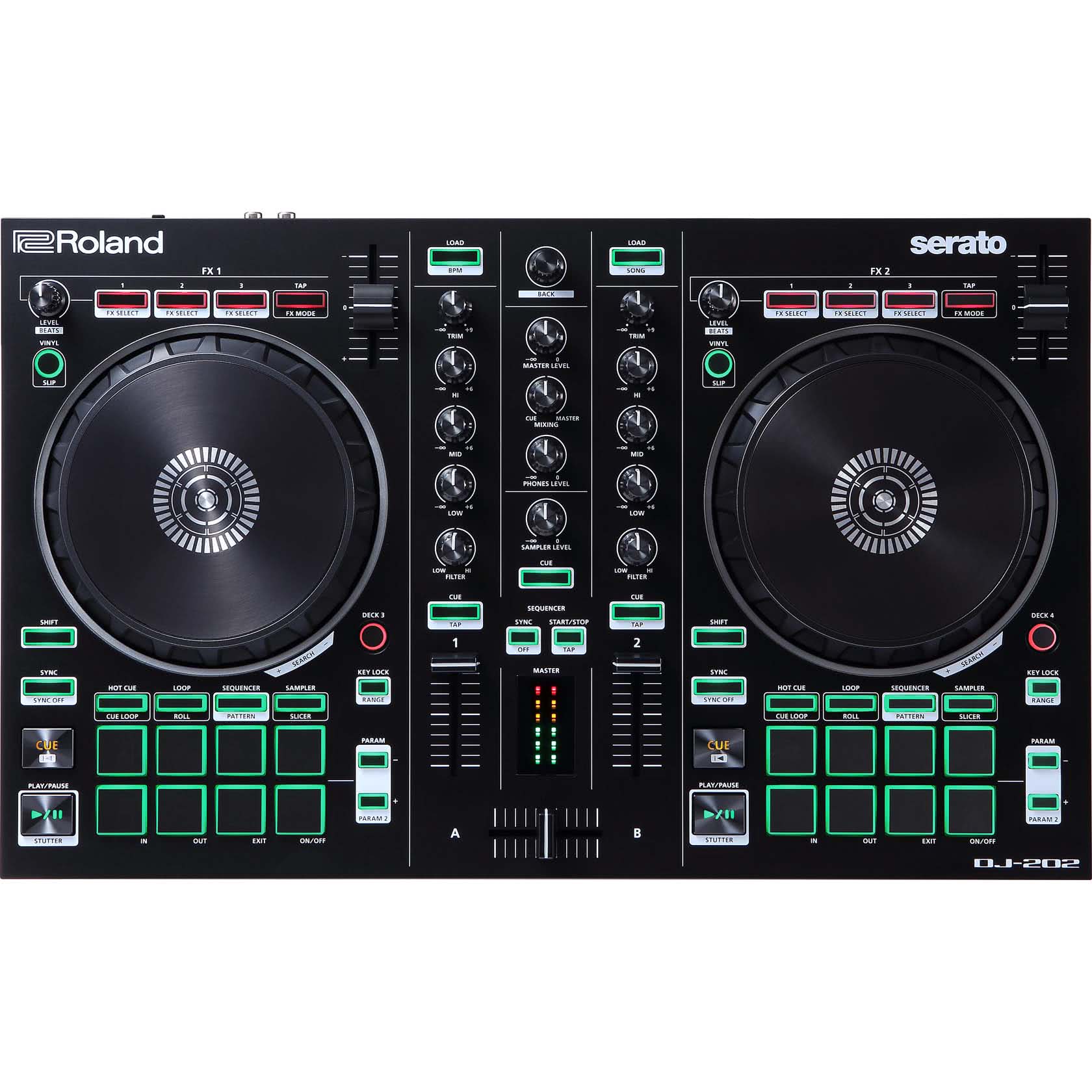
The layout follows the familiar structure of a DJ controller : decks on the outside, mixer in the middle and transport buttons below the jog wheels. Anyone who has already worked with Serato or a similar two-channel controller will quickly find their way around. The DJ-202 does not have a display, so track selection, waveforms and many status indicators remain on the laptop.

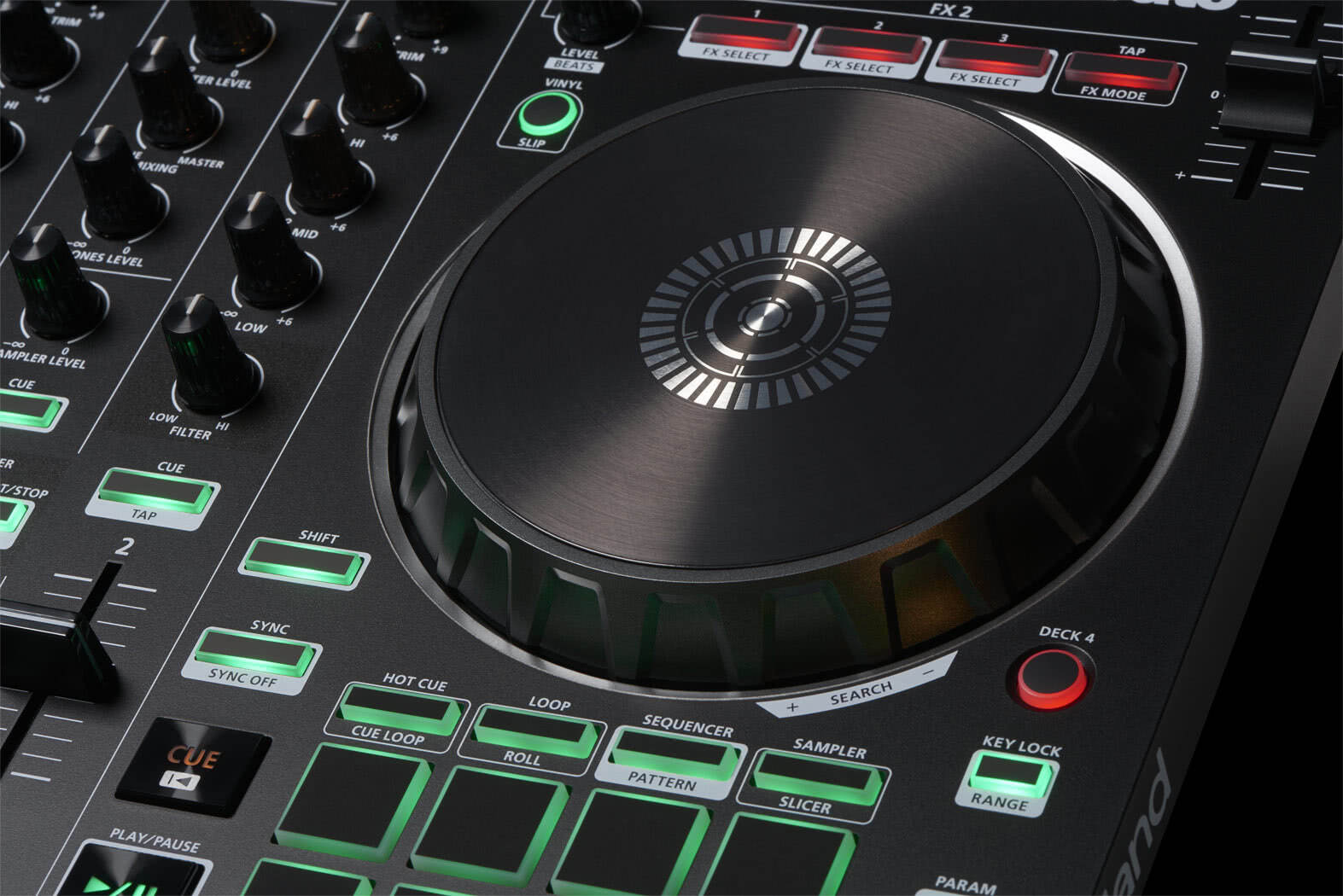
The two touch-sensitive jog wheels are among the strongest control elements of the controller. They react directly to touch on the top, can be pushed smoothly, and offer enough resistance for controlled corrections. They work convincingly for manual beatmatching and initial scratch techniques. In doing so, they feel significantly more mature than the small, very light jog wheels on many earlier entry-level models.

The 45-millimetre long channel faders and pitch faders are a compromise of the compact format. The channel faders are easy to adjust. When beatmatching manually, the short pitch fader requires a steady hand because even small movements noticeably change the tempo value. Sync is available directly as an alternative.

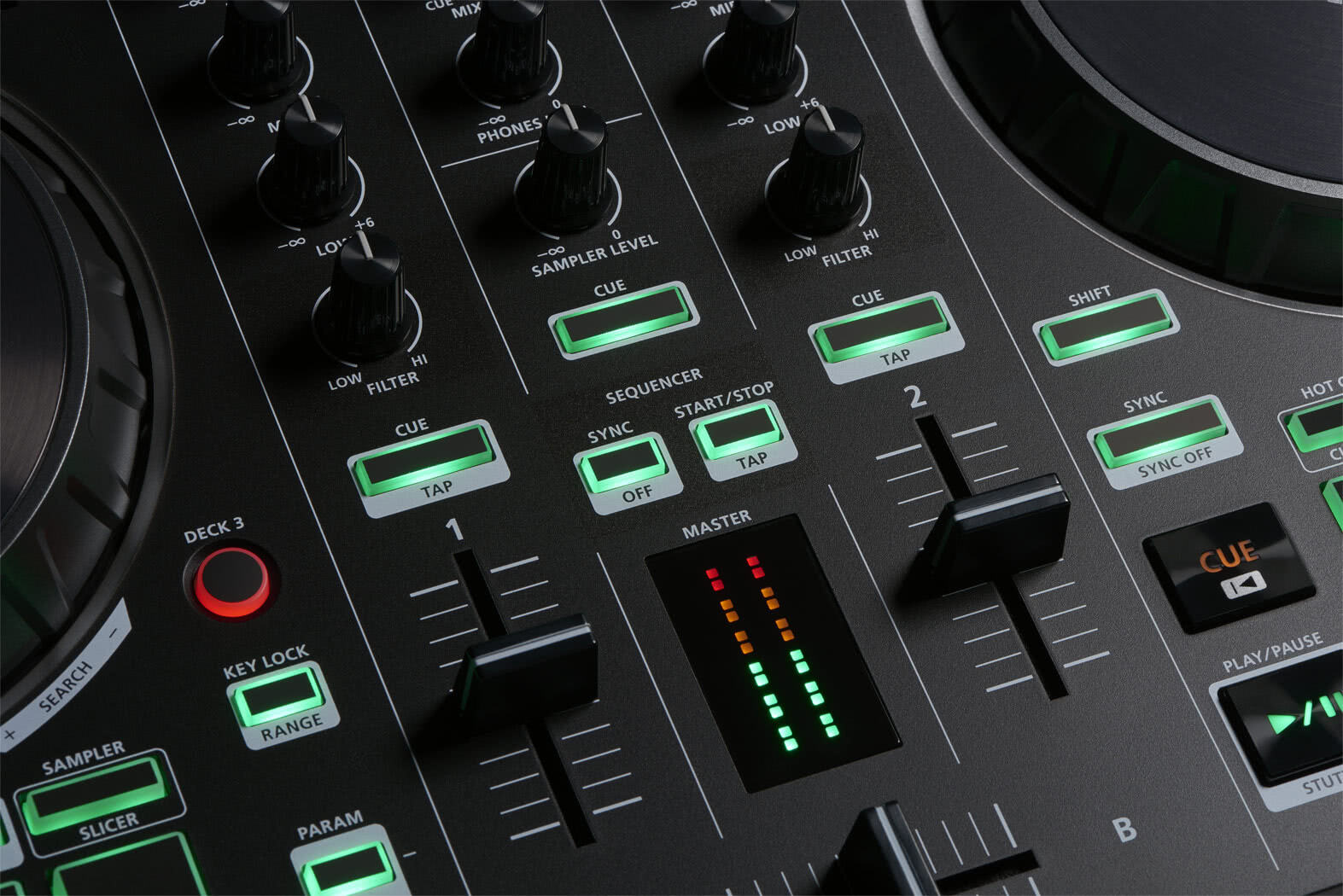
The mixer offers gain, a three-band EQ and a combined high and low-pass filter per channel. In addition, there are cue buttons, a crossfader, master level, headphone volume and a stepless cue-master mix. A dedicated sampler level control is also present. The central level meter shows the master; separate channel level meters are missing. When setting levels, you therefore have to look at the software regularly.

Roland DJ-202 review 2026 - Build quality and user interface

Performance pads, effects and four decks

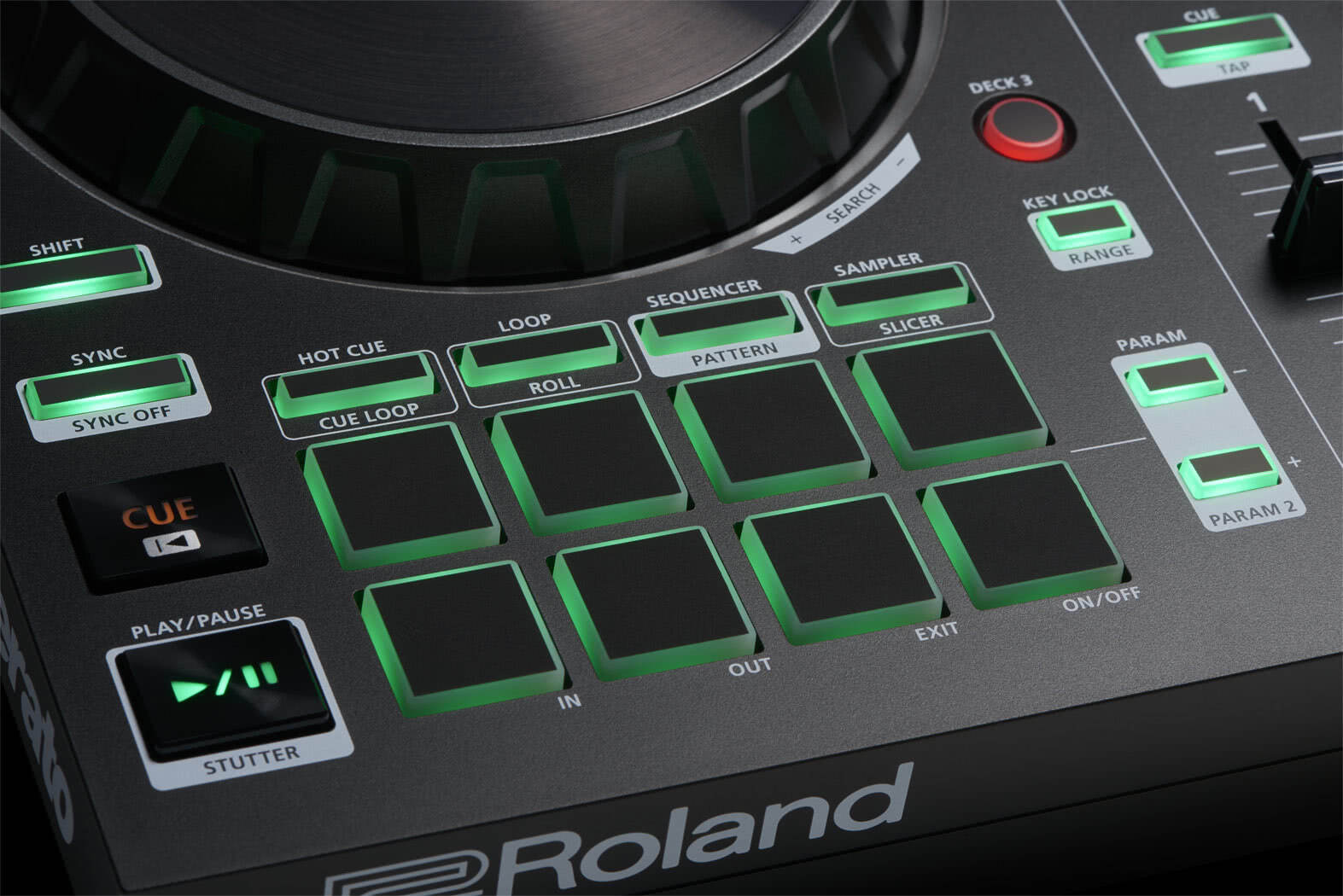
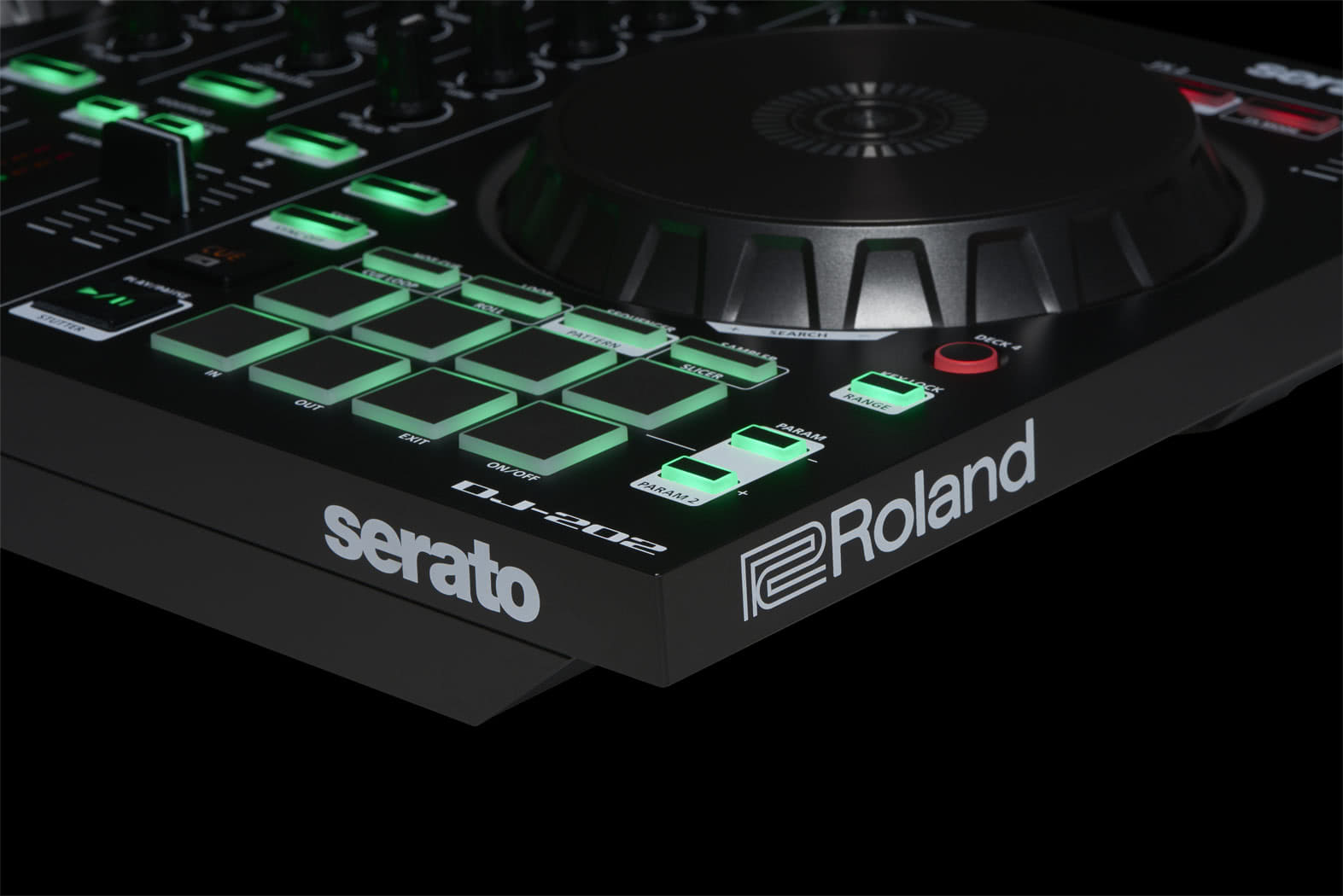
Under each jog wheel there are four green-lit pads. Together there are eight non-velocity-sensitive performance pads. They work in hot cue, loop, sequencer and sampler modes. The pads have a clear pressure point and are well-suited for setting cues or triggering samples, but feel more like compact buttons than soft, expressive drum pads.

The FX section controls up to three Serato effects per deck. Three buttons select or activate the effects, while a knob determines the intensity or beat length. This saves space, but is less direct than a dedicated knob per effect. The operation is sufficient for filter sweeps and simple echo or reverb transitions.

Using Deck Select, the DJ-202 can operate four Serato decks. However, the hardware remains a two-channel mixer. When switching between decks 1 and 3 or 2 and 4, the same fader controls different software channels. Anyone wanting to fade in an additional track must take the current fader position into account. Four decks are possible, but not as comfortable as on a professional four-channel controller.

Roland DJ-202 review 2026 - Performance pads, effects and four decks

TR sounds and 16-step sequencer

The sequencer distinguishes the DJ-202 from ordinary two-channel controllers even today. It contains sounds from the TR-808, TR-909, TR-606 and TR-707. Each kit provides eight instruments: bass drum, snare, closed and open hi-hat, tom, rim, clap and ride. The TR-808 remains relevant as a standalone classic in the environment of the Roland TR-8S , but here its sound library is housed in a significantly simpler user interface.

Patterns consist of 16 steps. The left and right pad groups together map the steps, while shift combinations select instruments, parameters and kits. Own Serato samples can also be sequenced. Finished patterns can be started and synchronised with a running deck; you can play sounds in directly via Inst-Rec.

This works and is fun when practising or for prepared transitions. The operation has many dual assignments: Many states are not labelled, and without a manual, it is hardly possible to recognise which instrument or pattern area is currently selected. Both long-term practical tests performed at the time of the market launch reached the same conclusion. The functions are extensive but require training.

During a set, the sequencer is therefore better suited for known, previously rehearsed sequences than for spontaneous experiments. An incorrect pad mode or an unsuitable layer cannot be recognised as quickly on the hardware as with a separate drum machine with a display and labelled steps. Those who only want to mix tracks can ignore the entire section. Those who consciously engage with it, however, get a creative function that even many newer controllers lack.

Roland DJ-202 review 2026 - TR sounds and 16-step sequencer

Sound and practical workflow

The internal audio processing works at 24-bit and 48 kHz. The master output provides a clean, sufficiently powerful signal for the intended device class. The RCA connection places more limits on the area of application than the sound quality itself. The equipment is consistent for home training, live streams and small events.

The basic workflow remains pleasantly direct: select a track with the browse knob, load it onto one of the decks, set a cue and mix. Transport buttons, jog wheels, EQ and filters are located where you expect them to be. The most important functions can be operated without a mouse. For library management, detailed effect selection and control of the deck layers, the laptop remains necessary.

With longer mixes, the lack of channel level meters and the short pitch faders are particularly noticeable. These are not flaws, but typical cost-saving measures of a compact controller. The DJ-202 rewards you for this with good jog wheels, a complete headphone section and a separate sampler level, which is genuinely useful when working with drum sounds.

Roland DJ-202 review 2026 - Sound and practical workflow

What has changed due to firmware updates?

The current system software carries version number 1.14 from November 2025. The number might initially suggest a long period of functional development. In fact, the latest updates have hardly changed the controller at all.

The most important package of functions arrived with version 1.10 in January 2018. Roland added the TR-606 and TR-707 sounds, increased the number of TR-S kits from eight to twelve, extended the adjustable BPM range from 40–300 to 5–500, and added settings for backspin length and the sensitivity of the jog wheel surface. After this update, a factory reset is necessary for the extended TR-S functions to be adopted correctly.

Version 1.11 from July 2019 fixed an error where TR-S did not work correctly with Serato DJ Pro 2.1.1 or newer. Versions 1.12 from 2021 as well as 1.13 and 1.14 from 2025 only changed the version management according to Roland; functions and specifications remained unchanged. A DJ-202 with older firmware should therefore be updated, but a fundamental modernisation of the hardware does not take place as a result.

Serato DJ Lite and DJ Pro in 2026

At the time of market launch, the controller was delivered with Serato DJ Intro. The software has been called Serato DJ Lite since 2018. Serato continues to officially list the DJ-202 as supported hardware. Connecting it unlocks DJ Lite; a separate hardware subscription is not necessary for this.

The basic functions include track management, two visible decks, hot cues, loops, samples and effects. Current Serato versions also offer music streaming via supported services. The respective subscriptions and availabilities apply to this; locally stored music remains the safer basis for a reliable performance.

Serato DJ Pro continues to be a paid upgrade. It extends, among other things, recording functions, cues, loops, effects and access to additional sampler banks. Some secondary assignments on the controller are only sensibly usable with Pro. Lite is sufficient for getting started, but anyone wanting to record sets or fully exhaust the hardware's potential should budget for the additional software price.

Strengths and limitations in the follow-up test

The two older video tests unanimously praised the large, responsive jog wheels and the extensive function package for the price class. This assessment stands. Even in 2026, the DJ-202 does not feel outdated for normal mixing. The basic controls react directly, and the arrangement is easy to understand.

The criticism of the sequencer remains equally valid. Its possibilities are interesting, but they are hidden behind several shift layers. Anyone who buys it just for the TR sounds and expects a self-explanatory drum machine will be disappointed. The creative added value requires practice and is more dependent on prepared muscle memory than on visible operational guidance.

Compared to newer entry-level controllers, modern convenience details are missing: USB-C, an additional 3.5 mm headphone jack, extensive status indicators and less nested pad operation. The purely Serato-oriented nature also limits the choice of DJ software. In return, the DJ-202 continues to offer the TR sequencer and the MIDI output. It is precisely this combination that decides whether its older design is a disadvantage or an advantage for you.

Is the Roland DJ-202 still recommended in 2026?

Yes, but not across the board. As a classic first DJ controller, the DJ-202 competes with younger models that have more modern connectivity and often offer a simpler software workflow. If you only want to mix two decks, set cues and occasionally use an effect, you should at least compare recent alternatives.

The DJ-202 remains recommended for Serato beginners who appreciate good jog wheels and really use the TR sequencer or MIDI out. It also serves its purpose as a lightweight secondary controller for home use or small mobile assignments. Official support from Serato and the firmware updated in 2025 argue against the concern of buying a completely abandoned product.

It is less suitable for DJs who connect external players, use long balanced lines to a PA, work without a laptop, or want to mix four decks simultaneously in comfort. Scratch DJs with high demands on the crossfader and pad performance will also quickly reach the limits of the entry-level class.

Roland DJ-202 review 2026 - Build quality and user interface

Conclusion on the Roland DJ-202

In 2026, the DJ-202 is no longer a modern all-around winner, but neither is it an obsolete device. Its foundation still works well: direct jog wheels, clear two-channel mixer, usable audio quality and official Serato support. The housing, short pitch faders and minimal connections are clear reminders of its price class and age.

It retains its special place due to the 16-step sequencer, the four TR sound families and the MIDI output. These functions are not self-running but require training. Anyone who specifically wants to work with these gets an unusually creative combination. Those who do not need them will frequently find more contemporary overall operation with newer entry-level controllers.

Strengths

  • Large, precisely reacting jog wheels
  • TR-808, TR-909, TR-606 and TR-707 sounds
  • Integrated 16-step sequencer for TR sounds and Serato samples
  • MIDI out for synchronisation of external devices
  • Serato DJ Lite continues to be officially supported
  • Lightweight, easily transportable housing

Weaknesses

  • Sequencer is heavily dual-assigned and difficult to access without a manual
  • Only RCA master output and 6.3 mm headphone jack
  • No inputs for external players or turntables
  • Short pitch faders and no separate channel level meters
  • Four decks can only be operated via cumbersome layers
  • Serato DJ Pro costs extra

Technical specifications

Channels / Decks 2 channels / 4 software decks
Software Serato DJ Lite, paid upgrade to Serato DJ Pro possible
Performance pads 8 in total, hot cue, loop, sequencer and sampler
Sequencer 16 steps, TR sounds and Serato samples
Drum kits TR-808, TR-909, TR-606 and TR-707
Audio 24-bit / 48 kHz
Connections USB-B, RCA master, 6.3 mm headphones, 6.3 mm microphone, MIDI out
Power supply USB bus power, 500 mA
Dimensions 478 x 297 x 62 mm
Weight 2.1 kg
Current firmware Version 1.14

Roland shows with the DJ-202 just how long an independent concept can remain relevant. In 2026, the purchasing decision depends less on age than on a simple question: Do you use the sequencer and MIDI out, or do you primarily want a modern, uncomplicated two-channel controller?