Questions? Personal advice: +49 9951 - 690 190
Product description RME Fireface UCX II
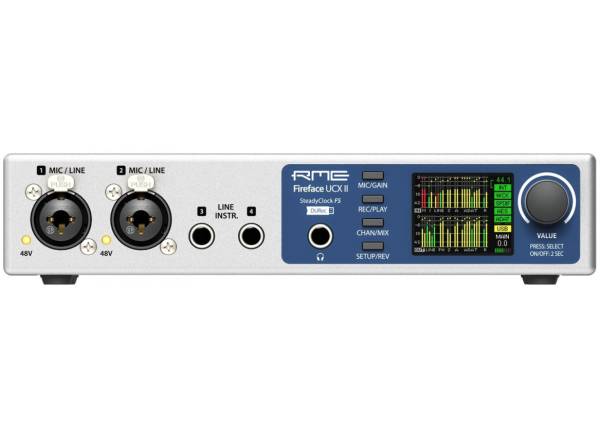
With the RME Fireface UCX II, you get a portable USB audio interface that combines, in a small space, many connection options, flexible signal routing, and standalone operation. The half-19-inch device is aimed at applications in the studio, in mobile recording, and in live settings, where you don’t want to give up on professional connection variety. Two Mic/Line inputs, two Line/Instrument inputs, additional analog Line I/Os, as well as ADAT, AES/EBU, SPDIF, Word Clock and MIDI ensure that the interface fits into very different setups. This is complemented by TotalMix FX, DURec for direct recording to USB storage, and SteadyClock FS for clean clocking.
Compact, but open to large setups
RME combines a very compact format here with equipment that goes far beyond classic desktop solutions. The device provides you with 40 channels for recording and playback and connects analog and digital sources without detours. On the front, you work directly with two Mic/Line preamps in the XLR combo format and two Line/Instrument inputs; on the back, you have additional balanced Line inputs and outputs for outboard gear, synths, monitors, or permanently wired studio connections.
Especially then, when your setup grows, this RME solution remains an interesting option. ADAT, AES/EBU, SPDIF coaxial, Word Clock and MIDI open up many possibilities for expansion, integration of external converters, or synchronisation of multiple devices. This creates an interface that not only fits your needs today, but also keeps its place in more complex production environments.
Direct access without detours
The Fireface model is not dependent on being permanently connected to a computer. Using front buttons, encoders, and a colour display, you control important functions directly on the device. The standalone function is particularly practical: multiple device states can be saved in the internal memory, so you can quickly recall different working environments.
This is especially useful when you switch between recording, live use, and fixed routing. Instead of having to configure everything again each time, you call up prepared setups and carry on immediately. This direct usability makes the interface not only more flexible, but also more practical in everyday situations where things need to happen quickly.
Recording without a computer
With DURec, the interface becomes more than just a switching hub. The integrated recording function writes all inputs and outputs directly to a USB storage medium via the connection on the rear. That way, you use the device as a standalone recorder for rehearsals, concerts, sessions, or virtual sound checks—without a Mac or PC having to run.
Playback of already recorded tracks in a live context is also very interesting. Channels can be selected specifically for recording and playback, giving you significantly more freedom in practical use. For mobile applications or smaller production environments, it saves you paths, devices, and additional sources of error.
Routing, monitoring, and control
TotalMix FX is one of the points that has made RME interfaces so versatile for years. You get an extensive mixing and monitoring environment with latency-free monitor mixes, routing options, and integrated effects such as EQ, dynamics, reverb, and delay. This allows you to set up headphone mixes, monitor paths, and various output scenarios very precisely.
On top of that, there’s DigiCheck for precise analysis and measurement tasks. This is particularly valuable when you want to cleanly monitor levels, digital signals, or complex routings. For many setups, this combination of hardware and software replaces an additional external mixer or meaningfully extends existing workflows.
Clean clock, well thought-out outputs
With SteadyClock FS, RME relies on a very precise clock architecture with strong jitter suppression. For you, that means stable synchronisation in the digital chain and a reliable basis for ADAT-, AES-, SPDIF-, or Word Clock setups. Especially when multiple digital devices work together, this is a point that makes a clear difference in everyday use.
In addition, the interface offers DC-coupled outputs. This is particularly interesting if you work with CV/Gate and want to integrate modular systems. With this, the device doesn’t just appeal to classic recording and mixing environments, but also to users who want to bring audio and control signals together flexibly in a central hub.
Does the RME Fireface UCX II fit your workflow?
This interface is a great choice when you want more than just inputs and outputs at the computer. It’s suitable for ambitious home studios, professional production stations, mobile multi-track recording, and live setups with clear requirements for routing, stability, and standalone operation. Thanks to the straightforward operation, it’s also accessible for experienced beginners—however, its depth really comes into its own when you build more complex signal chains or want to integrate external hardware cleanly.
- Suitable for recording, mixing, and mobile multi-track setups
- Useful for hybrid studios with analog and digital peripherals
- Interesting for live applications with direct recording to USB storage media
- Strong choice if you work with TotalMix FX, external converters, or CV/Gate
Features RME Fireface UCX II
-
Portable 40-channel USB audio interface in a compact half-19-inch format for studio, live, and mobile applications
-
Two Mic/Line inputs in XLR combo format on the front
-
Two Line/Instrument inputs on the front with digitally controllable gain
-
Eight analog I/Os plus a separate headphone output for flexible monitoring and signal routing
-
Digital connections with ADAT, AES/EBU, SPDIF coaxial, Word Clock, and MIDI
-
Standalone operation with saved device states and direct control via display, buttons, and encoders
-
DURec for direct recording and playback via USB storage media without a computer
-
TotalMix FX and DigiCheck for routing, monitoring, effects, and precise analysis functions
-
SteadyClock FS for jitter suppression and stable digital synchronisation
-
DC-coupled outputs for applications with CV/Gate and modular systems
Technical data
-
Channels
40
-
Audio interface type
USB 2.0 Audio Interface
-
Analog inputs
8
-
Analog outputs
8
-
Microphone inputs
2 x Mic/Line Input
-
Instrument inputs
2 x Line/Inst Input
-
Headphone output
1 x Phones Output
-
Digital connections
1 x AES I/O | 1 x ADAT I/O | 1 x SPDIF I/O Coax | 1 x Word Clock I/O | 1 x MIDI I/O
-
Supported sample rates
28 kHz to 200 kHz
-
AD converter resolution
24 Bit
-
DA converter resolution
24 Bit
-
Microphone inputs 1-2
XLR, electronically balanced | Input impedance: 5.4 kOhm | Gain range: 75 dB | ON: -128 dBu A-weighted at 60 dB gain
-
Line/Instrument inputs 3-4
TRS balanced or TS unbalanced | Instrument impedance: 1 MOhm | Additional digital gain: 0 to +24 dB
-
Line inputs 5-8
6.3 mm stereo jack, electronically balanced | Input impedance: 8 kOhm unbalanced | 12 kOhm balanced | Gain: 0 to +12 dB
-
Line outputs 1-6
6.3 mm stereo jack, servo-balanced | Maximum output level: +19 dBu | Output level switchable: +19 dBu | +13 dBu | +4 dBu
-
Phones output 7-8
6.3 mm stereo jack, unbalanced | Output impedance: 1 Ohm | Max output power per channel at 32 Ohm: 210 mW
-
MIDI
1 x MIDI I/O via 5-pin DIN sockets
-
Power supply
external power supply unit
-
Power consumption
typical 13 Watts
-
Weight
0.91 kg
-
Dimensions (W x D x H)
215 x 130 x 44 mm
Am Pfanderling 60
85778 Haimhausen
Germany
1 review
Immer wieder RME
Bin mit dem UFX III super zufrieden. Daher gleich das UCX II als ADAT Erweiterung und als mobiles Interface hinterher. RME ist klasse.
Important questions about the article RME Fireface UCX II
Question: Can the RME Fireface UCX II operate without a computer?
Answer: Yes. In standalone mode, settings can be operated directly on the unit and six device states can be stored permanently; TotalMix FX can also be controlled via MIDI.
Question: Can I make multitrack recordings without a computer?
Answer: Yes. DURec records selected inputs and outputs directly to USB storage devices up to 2 TB and plays recordings back. The recorder works via the internal DSP independently of Windows or Mac.
Question: Which analogue sources can I connect directly?
Answer: The front panel provides two mic/line inputs with XLR combo sockets as well as two line/instrument inputs. This means no external preamp is mandatory for microphones, synthesizers and instruments.
Question: Can the interface be integrated into a digital studio setup?
Answer: Yes. It offers ADAT, AES/EBU, coaxial SPDIF, Word Clock and MIDI in addition to the analogue connections. This lets it connect to digital converters, preamps and other studio equipment.
Question: Does the Fireface UCX II work with Windows, Mac and Linux?
Answer: In Class Compliant mode, it is recognised by Windows, macOS and Linux without a proprietary driver. However, fewer functions are available than in RME driver mode.
Question: Is mixer and monitoring software included?
Answer: Yes. TotalMix FX provides routing, multiple latency-free monitor mixes as well as EQ, dynamics, reverb and delay; DigiCheck is used to measure and analyse digital audio signals.
Question: Is the interface suitable for modular synthesizers?
Answer: Yes. The line outputs are DC-coupled and can therefore output CV and gate signals to compatible modular synthesizers and studio hardware.