Average rating of 4.6 out of 5 stars
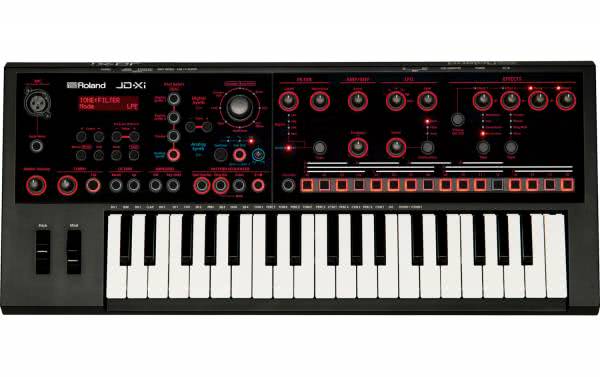
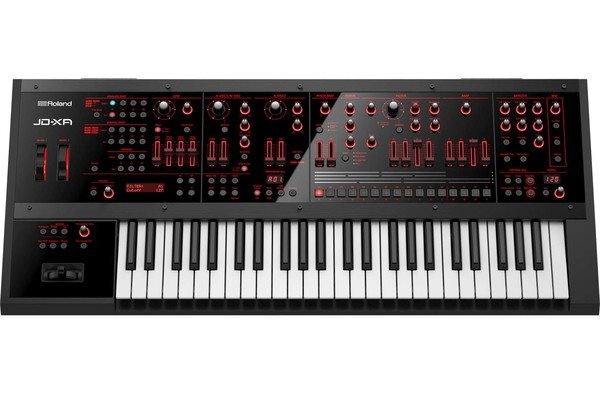
A musical idea often only becomes tangible when bass, pads, beats, and a voice interact directly. The Roland JD-Xi combines exactly these layers in one compact keyboard: analogue sound generation, digital synthesizer parts, drums, and a sequencer for patterns and loops. Analogue core and digital timbres The monophonic analogue synthesizer section creates basses and leads with sawtooth, triangle, or square waves. Pulse width modulation, an analogue filter, and an independent sub-oscillator provide a solid foundation for deeper sound programs and can be shaped directly on the device. Two digital parts complement it with SuperNATURAL sounds such as pads, string sections, electric pianos, and effects. This allows for the combination of a punchy analogue bass and expansive digital soundscapes in one arrangement. Four tracks for patterns and song ideas The 4-track pattern sequencer manages two digital synthesizer parts, the analogue synthesizer, and the drums separately. Real-time and step recording are available for different working styles; with TR-REC, you can program beats in the style of classic Roland drum machines. The PCM drum section brings electronic and acoustic kits to the device. Individual drum sounds can be adapted to your own pattern via filter, envelope, pitch, and pan. Vocoder and gooseneck microphone The included gooseneck microphone connects voice and synthesizer without additional accessories. The vocoder transfers the pitch and sound character of the played notes to speech or singing, while AutoPitch is intended for clearly processed electronic vocal sounds. With Auto Note, a synthesizer sound can be triggered via the voice. This is suitable for rough ideas, short vocal hooks, and performative passages where your hands are busy working on knobs or the sequencer. Effects and integration into your setup Four simultaneously usable effect sections process the sounds: Effect 1, Effect 2, Delay, and Reverb. Bit Crusher, Slicer, or Ring Mod significantly alter individual parts, while Delay and Reverb provide spatial depth. Via USB, the synthesizer transmits audio and MIDI to the computer. MIDI In and Out, stereo outputs, a headphone jack, as well as an XLR microphone input and jack audio input make it highly compatible with other equipment. When does the Roland JD-Xi fit into your musical setup? The Roland JD-Xi is suitable for producers, live performers, and beginners in sound synthesis who want to capture ideas without needing a massive collection of equipment. 37 velocity-sensitive mini keys, the clearly separated parts, and 256 memory slots for your own programs give you a compact foundation for electronic music, beat sketches, and supplementary keyboard tracks. The instrument also integrates well as a second keyboard in the studio or as a mobile sound source. If you want to combine analogue bass and lead sounds with digital pads, drums, and vocal effects in one workflow, the JD-Xi provides these tools directly on the device. Features Roland JD-Xi Compact crossover synthesizer with analogue and digital sound generation Monophonic analogue synthesizer with sub-oscillator and analogue filter Two digital synthesizer parts with SuperNATURAL sounds 37 velocity-sensitive mini keys PCM drum section with editable drum sounds 4-track pattern sequencer with real-time, step, and TR-REC recording Vocoder, AutoPitch, and Auto Note for vocal effects Gooseneck microphone included Four effect sections with Effect 1, Effect 2, Delay, and Reverb USB audio and USB MIDI for connection to the computer MIDI In and MIDI Out for external equipment 256 memory slots for your own programs Technical specifications Sound generationMonophonic analogue synthesizer | 2 digital SuperNATURAL synthesizer parts | PCM drum section Keyboard37 mini keys with velocity sensitivity Sequencer4 tracks | Real-time recording | Step recording | TR-REC Vocal effectsVocoder | AutoPitch | Auto Note EffectsEffect 1 | Effect 2 | Delay | Reverb Audio inputsXLR microphone input | 6.3 mm jack audio input Audio outputsStereo output, 6.3 mm jack Headphone connection6.3 mm stereo jack MIDIIn | Out | USB-MIDI USBType B for audio and MIDI User programs256 Power supplyAC adaptor Weight2.2 kg Dimensions (W x D x H)575 x 245 x 85 mm Included in delivery Roland JD-Xi synthesizer Gooseneck microphone AC adaptor Owner's manual
Average rating of 4.58 out of 5 stars
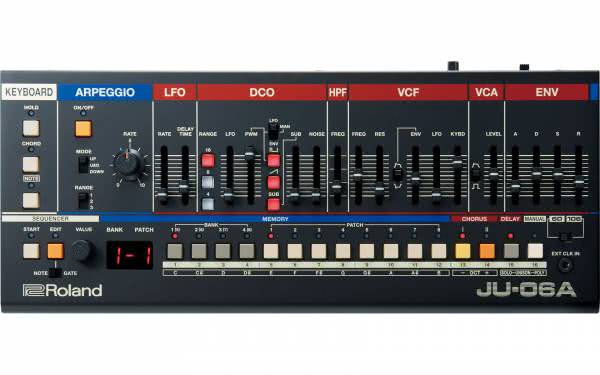
A JUNO sound thrives on direct sound shaping: one slider for the filter, another for the envelope, plus chorus and arpeggio. The Roland JU-06A brings this workflow into a compact Boutique module, combining the two sound modes of the historic JUNO-60 and JUNO-106 synthesizers. Two JUNO modes with unique filter characteristics Using the switch on the front panel, you can toggle between 60 and 106 modes. This gives you access to the two distinct filter behaviours of the original models: in 106 mode, the high-pass filter works continuously, while 60 mode features pulse width modulation controllable via the envelope. Four voices of polyphony are sufficient for chords, pads, and compact hooklines. The sound generation follows the familiar architecture with DCO, sub-oscillator, noise, high-pass filter, resonant VCF, VCA, and ADSR envelope. All important parameters are laid out as knobs and switches in front of you. This allows you to modify sounds while playing without having to navigate through menus. Chorus, delay, and musical performance aids The integrated chorus is a defining characteristic of the JUNO series. The JU-06A features two chorus variants; a delay complements the range of effects. For held chords, there is a hold function and chord memory with 16 storage slots, allowing a played chord to be triggered via the performance buttons. The arpeggiator operates in Up, Up&Down, and Down modes and offers three octave ranges. This is practical for sequenced bass lines, rhythmic chords, or a quick idea between two takes. The 16-step sequencer stores 16 patterns and records monophonic note sequences. Synchronised in a hardware or computer setup For integration, MIDI In and Out as well as USB for audio and MIDI are available. This allows the sound module to be played and synchronised from a master keyboard, a DAW, or an external sequencer. Via the external clock input, an analogue or modular setup can also clock the internal sequencer. A MIX-IN, a stereo output, and a separate headphone output are provided as mini-jack sockets. Operation is possible via USB bus power or four AA batteries. With Ni-MH batteries, the continuous operating time is about six hours; this depends on the capacity, battery type, and usage conditions. The built-in speaker makes it easy to preview sounds without a separate monitoring system. Roland Boutique format for on the go and at the desk With a width of 300 mm, the module fits on a small workspace or into a mobile bag. The 16 performance buttons allow for the direct playing of simple melodies and chords; when connected to an external keyboard, the JU-06A becomes a fully playable sound source. For a standalone Boutique unit, the optional K-25m Keyboard Unit can be attached. The separately available DK-01 Boutique Dock also matches the format and allows for three tilt angles. Those who organise patches will find 64 storage slots each for 60 and 106 modes. This keeps various basic sounds for production, live sets, or sound design available directly within the device. Who is the Roland JU-06A for? The Roland JU-06A is for you if you want to combine the clear layout of classic JUNO sounds with modern MIDI and USB connectivity. Electronic musicians, producers, and live acts get a small module for chords, pads, bass lines, and arpeggios that fits quickly into existing hardware or a DAW. The format is also useful for mobile idea generation: battery operation, built-in speakers, and storable sequences make the synthesiser independent of a fixed studio location. With a master keyboard or the optional K-25m, it becomes a directly playable instrument for sketches, arrangements, and use on stage. Features Roland JU-06A Digital Roland Boutique sound module with sound modes for JUNO-60 and JUNO-106 Four-voice polyphony for chords, pads, and melodies Switchable filter characteristics for both JUNO modes DCO section with sawtooth, square, sub-oscillator, pulse width modulation, and noise Two chorus variants and integrated delay Arpeggiator with Up, Up&Down, and Down modes as well as three octave ranges 16-step sequencer for monophonic note sequences with 16 pattern storage slots 16 chord memory slots MIDI In/Out, Micro-B-USB for audio/MIDI, and external clock input Operates via USB bus or four AA batteries Integrated speaker as well as headphones, output, and MIX-IN jack Compatible with optional K-25m Keyboard Unit and DK-01 Boutique Dock Technical specifications Sound generationDigital Sound modes60 | 106 Polyphony4 voices Patch memory64 for 60 mode | 64 for 106 mode Chord memory16 storage slots Sequencer16 steps | monophonic | 16 patterns Effects2 chorus variants | delay ArpeggiatorUp | Up&Down | Down | 3 octave ranges ConnectionsEXT CLOCK IN | PHONES | OUTPUT | MIX IN | MIDI In/Out | Micro-B-USB USBAudio | MIDI Power supplyUSB bus | 4 x AA Ni-MH batteries | 4 x AA alkaline batteries Power consumption500 mA via USB bus Battery lifeapprox. 6 hours with Ni-MH batteries during continuous operation Weight0.995 kg Dimensions (W x D x H)300 x 128 x 49 mm Included in delivery Roland JU-06A sound module 4 x AA alkaline batteries Owner's manual Safety leaflet
Average rating of 5 out of 5 stars
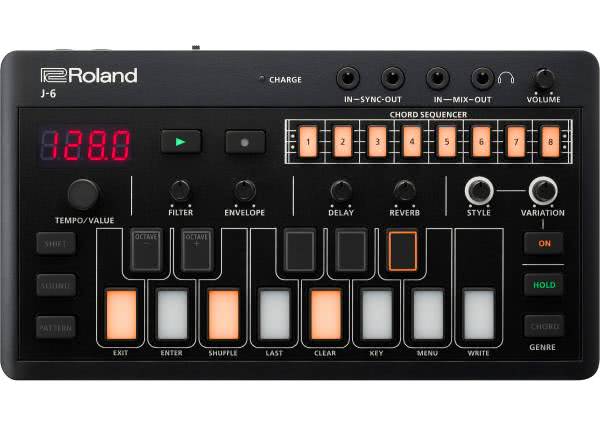
A chord progression can carry a track, but on a small keyboard, it often emerges from an idea faster than from theory. The Roland AIRA Compact J-6 combines a chord sequencer with the sound architecture of the JUNO-60 and keeps both ready in a handy instrument. Chords, rhythmic movements, and synthesizer sounds can be merged directly on the device. Enter chord progressions without music theory A hundred chord sets cover classic and contemporary styles. You select a set and play the corresponding chords via the keys. This is suitable for initial song sketches, backing pads, and spontaneous ideas when you need a harmonic foundation quickly. Nine styles with twelve variations each add arpeggios and rhythmic phrases to sustained chords. The hold function keeps the pattern running while you prepare the next sound or variation. 108 style variations provide simple progressions with different movements. Chord sequencer for your own patterns The sequencer saves 64 user patterns, each with up to 64 steps. You can define chords, style variations, individual notes, and tempo changes within the steps. This allows the J-6 to play a prepared accompaniment or serve as a starting point for other instruments. The compact keyboard also plays the internal sound directly. The engine can also be controlled from an external controller via MIDI. This allows the chord synthesizer to work independently in a small desktop setup while simultaneously serving as a sound module. Four-voice JUNO-60 sound The four-voice synthesizer engine is based on Roland's ACB technology and replicates the sound character of the JUNO-60. 64 preset patches are immediately available. Filter and envelope controls adjust the sound directly without needing to open a menu. Delay and reverb complement the sound design. This allows you to shape the spatial characteristics of chord pads, rhythmic figures, and lead lines directly on the device. 64 presets provide a practical basis for various musical sketches and running patterns. Audio, MIDI and sync in the AIRA Compact setup The J-6 features a stereo mix-in, stereo mix-out/headphones, MIDI-in, and MIDI-out, as well as separate sync-in and sync-out jacks in minijack format. This allows it to be connected to other AIRA Compact devices, hardware instruments, and an external clock signal. Via USB-C, the instrument works as a class-compliant audio/MIDI interface and requires no drivers. The connection simultaneously charges the integrated lithium-ion battery. One charge lasts for up to 4.5 hours of continuous operation. When does the Roland AIRA Compact J-6 meaningfully complement your setup? The Roland AIRA Compact J-6 is suitable for producers, live acts, and beginners who want to develop chord progressions quickly and capture them as patterns. Its operation brings chord sets, variations, and sequencing close together. This is particularly practical for song ideas on the go, compact desktop rigs, and performances with recurring harmonic structures. Combined with drum machines, bass synthesizers, or a DAW, the small synthesizer provides chords, arpeggios, and its own JUNO-inspired sound. It is also easily integrated as an externally controlled sound module. The battery and low weight make it easy to take the instrument between your workspace, rehearsals, and sessions. Features Roland AIRA Compact J-6 Compact chord synthesizer with four-voice JUNO-60 synthesizer engine 100 chord sets covering classic and contemporary music styles Nine styles with twelve variations each for arpeggios and rhythmic phrases Chord sequencer with 64 user patterns and up to 64 steps per pattern 64 preset patches based on the JUNO-60 sound architecture with ACB technology Direct controls for filter and envelope Integrated delay and reverb effects Stereo mix-in as well as stereo mix-out/headphone connection MIDI and sync inputs/outputs in minijack format Class-compliant USB-C audio/MIDI interface with battery power Technical specifications Sound engineFour-voice JUNO-60 engine with ACB technology Preset patches64 User patterns64 SequencerUp to 64 steps Styles9 | 12 variations per style EffectsDelay | Reverb Display7-segment LED | 4 characters ConnectionsSync In | Sync Out | Mix In | Mix Out/Phones | MIDI In | MIDI Out | USB-C USBUSB-C Audio | MIDI | Bus Power Power supplyIntegrated lithium-ion battery | USB bus power Current draw500 mA Battery lifeUp to 4.5 hours Charging timeApprox. 3 hours Weight0.295 kg Dimensions (W x D x H)188 x 106 x 36.2 mm Included in delivery Roland AIRA Compact J-6 Chord Synthesizer USB-C to USB-A cable "Read Me First" leaflet
Average rating of 4.57 out of 5 stars
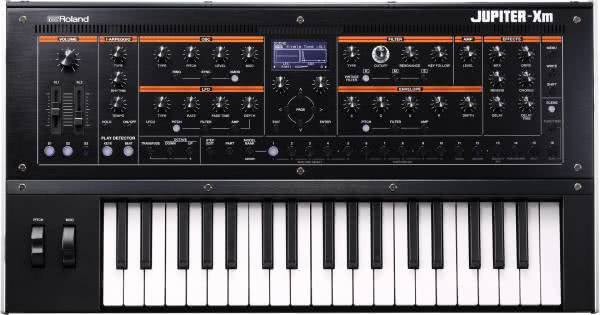
If you prefer not to start a musical idea at the computer, you need an instrument that brings sounds, accompaniment, and direct control together in one place. The Roland JUPITER-Xm consolidates this workflow into a compact 37-key synthesiser, combining the ZEN-Core sound engine with internal speakers, battery power options, and wireless communication. Roland sound worlds in one instrument Various Roland models and sound types work together inside. You can use classic synthesisers such as the JUPITER-8, JUNO-106, SH-101, and JX-8P, call up digital sounds from the XV-5080, or incorporate RD-pianos and drum sounds. This allows you to create setups that are just as suitable for electronic productions as they are for keyboard pads, leads, and rhythmic parts. Up to five parts simultaneously form a Scene: four for synthesisers and one for drums. A bass split with the SH-101 and JUNO-106, a piano with a string layer, or multiple stacked synth sounds can be assembled directly in the device. This creates room for dense arrangements without needing every voice to come from a separate sound engine. I-Arpeggio for accompaniment and pattern ideas The I-Arpeggio processes played notes, rhythms, and phrases, supplementing them with matching drum parts, basslines, chords, and arpeggios. It works across all five parts, allowing an idea to quickly evolve into a more complete musical context. The generated patterns can be adjusted and exported to a DAW for further production. Knobs, layers, and effects directly accessible The display is accompanied by large knobs, sliders, and buttons. These allow you to manipulate sound parameters, switch between synth layers, and control the effects section without complex workflows. The direct user interface is particularly practical when you need to change a sound during performance or adjust a layer spontaneously. Work mobile with speakers, batteries, and Bluetooth The 37 slim keys keep the instrument portable while providing three octaves for musical ideas on the go. Two integrated speakers often make a separate monitor for sketches and rehearsals unnecessary. You can stream audio via Bluetooth and control software instruments on your Mac or iPad using Bluetooth MIDI. For mobile use, the synthesiser can also be powered by batteries. In the studio, the balanced outputs, MIDI sockets, and pedal connections connect the device to other equipment. The metal-reinforced construction is designed for regular playing, rehearsals, and live performances. Software workflow and expansions With ZENOLOGY Pro, you can design sounds on your computer and subsequently use them in the hardware instrument. Conversely, JUPITER-Xm sounds are also available for DAW projects. Compatible Model Expansions and further ZEN-Core content expand the sound library, allowing the instrument to be updated with new models and sounds. Is the Roland JUPITER-Xm the right sound hub for you? The Roland JUPITER-Xm is right for you if you want to bundle multiple Roland sound characters into one compact instrument and shape sounds directly while playing. Keyboardists, producers, and live musicians gain an independent sound engine for layers, splits, and rhythmic ideas. Thanks to speakers, battery operation, and Bluetooth, the device remains highly usable for writing sessions away from your fixed studio setup. Features Roland JUPITER-Xm Compact synthesiser with 37 slim keys and ZEN-Core synthesis system Up to five parts simultaneously: four synth parts and one drum part Roland models such as JUPITER-8, JUNO-106, SH-101, and JX-8P Digital sounds from the XV-5080 as well as RD-pianos and drum sounds I-Arpeggio creates supplemental drum, bass, chord, and arpeggio parts I-Arpeggio patterns are adjustable and exportable to DAW Display, knobs, sliders, buttons, and dedicated effects section Integrated speakers for playing without external monitoring Bluetooth audio and Bluetooth MIDI for Mac and iPad Balanced connections, MIDI sockets, and pedal connections Compatible with ZENOLOGY Pro and ZEN-Core content Supports Model Expansions for additional sound models Technical specifications Keyboard37 slim keys Sound engineZEN-Core synthesis system Parts4 synth parts | 1 drum part PresetsOver 4000 instruments | Over 90 drum kits | 512 user presets DisplayLCD | 128 x 64 px Multi-effects4 systems | 93 types Effects5x part EQ | Overdrive | 8x Reverb | 5x Chorus | 5x Delay | Mic NS / Comp | Master EQ / Comp Speakers2 x 4 W BluetoothVersion 4.2 | A2DP | GATT Power supplyAC adapter | Battery operation possible Weight4.4 kg Dimensions (W x D x H)576 x 308 x 93 mm Included items Roland JUPITER-Xm synthesiser AC adapter Power cord Owner's manual
Average rating of 5 out of 5 stars
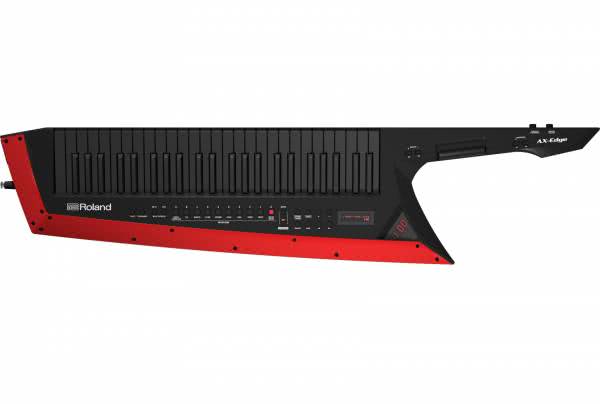
A keyboard can hardly leave the centre of the stage, but a keytar can. If you want to move freely while playing and shape sounds directly at the instrument, the Roland AX-Edge combines a sound engine, performance keyboard and performance controls in a portable format. 49 keys for melodies, chords and expression The 49 keys with velocity sensitivity and channel aftertouch give you enough room for lead lines, chord parts and two-handed playing. The ZEN-Core sound engine works with over 500 preset tones; you can store your own sound combinations in 320 user programs. The instrument manages four parts plus one vocoder part. Splits and layers can be adapted to your playing style, while favourite buttons make important sounds accessible without time-consuming searching. Direct control on the neck of the keytar The pressure-sensitive ribbon controller, the modulation bar and an assignable knob are located where your left hand operates anyway while playing. In addition, there are seven assignable buttons for functions that you quickly need in your live setup. With Tone Remain, you can switch programs without abruptly cutting off held notes or fading effects. The arpeggiator, song player and vocoder expand the performance with rhythmic accompaniment, audio playback and processed vocals. Edit sounds and control external sound generators Via Bluetooth MIDI, the keytar communicates wirelessly with the AX-Edge Editor app for iOS and Android. There you can edit sounds while the instrument itself remains on your shoulder. USB memory stores data on a USB stick. As a MIDI master keyboard, the AX-Edge also controls sound modules or software instruments. MIDI In/Out and USB Computer with USB-MIDI complement the wireless connection. This allows it to fit into both a standalone stage rig and a computer setup. Connections and power supply for the performance For the audio signal, L/Mono and R outputs are available in 6.3 mm format. A microphone input, a stereo headphone output and a pedal connection expand the range of applications; classic MIDI sockets are also available. The AX-Edge works with the included 9V power supply unit or with eight rechargeable Ni-MH AA batteries. With batteries, the operating time is approximately four hours, depending on the conditions of use. At 4.2 kg without the power supply unit and batteries, the instrument remains manageable for mobile use. When does the Roland AX-Edge usefully complement your live setup? The Roland AX-Edge is suitable for keyboardists who want to play their parts in front of the stage while keeping their hands on a full-sized instrument. The combination of a performance keyboard, neck controllers and program memory supports bands, solo acts and show productions with frequent sound changes. The keytar also offers a practical interface for musicians who control existing sound generators or plug-ins from the instrument. Bluetooth MIDI, USB-MIDI and the MIDI sockets give you multiple ways to do this, while battery power and a strap make movement on stage easier. Features Roland AX-Edge Portable keytar with ZEN-Core sound engine for live performances 49 keys with velocity sensitivity and channel aftertouch Over 500 preset tones, 320 user programs and 256 user tones Four parts plus vocoder part for splits, layers and vocal sounds Ribbon controller, modulation bar, assignable knob and seven assignable buttons Tone Remain for program changes without cut-off notes and effect tails Arpeggiator, song player, vocoder and favourite function Bluetooth MIDI and AX-Edge Editor for iOS and Android MIDI master keyboard function for modules and software instruments Power supply unit or battery operation with eight rechargeable Ni-MH AA batteries Technical data Sound engineZEN-Core Keyboard49 keys with velocity sensitivity and channel aftertouch Parts4 parts | 1 vocoder part Preset tonesOver 500 User programs320 User tones256 BluetoothMIDI over Bluetooth 4.1 LE OutputsL/Mono | R, each 6.3 mm jack InputsMicrophone, 6.3 mm jack | Pedal MIDIIn | Out | USB-MIDI | Bluetooth MIDI Power supply9 V DC power supply | 8 x Ni-MH AA battery Battery lifeApproximately 4 hours with rechargeable Ni-MH batteries Weight4.2 kg without power supply and batteries Dimensions (W x D x H)1252 x 291 x 85 mm Scope of delivery Roland AX-Edge Keytar Power supply unit Power cord Strap Blade panel with Allen key and screws Ferrite core with fastening band Owner's manual Safety leaflet
Average rating of 3.67 out of 5 stars
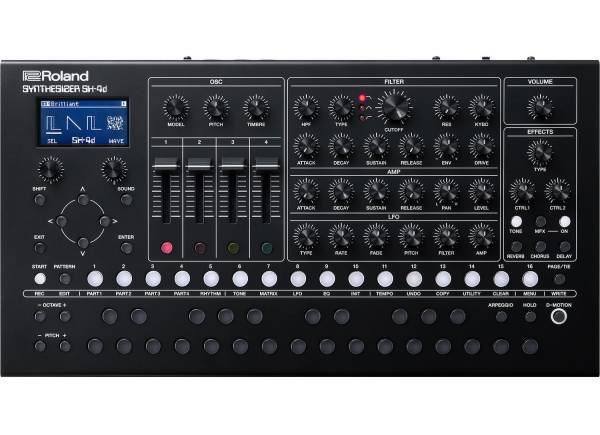
Ideas for a track often do not arise in the order in which they are heard later. First a bassline, then a percussive accent, followed by a chord change. The Roland SH-4D brings together multiple sound engines, a rhythm part, and a sequencer into a compact desktop instrument that can capture and further shape such sketches immediately. Five parts for sounds and rhythm Four independent tone parts and a dedicated rhythm part form the heart of the synthesizer. The total polyphony of up to 60 voices is sufficient for multi-layered patterns and complete grooves; the actual available number depends on the sounds used and the load on the sound engine. The rhythm part manages 49 preset kits and 64 memory slots for your own kits. A kit can contain up to 26 instruments. Synthesis parameters, two combinable waveforms, and a dedicated EQ are available for every instrument, allowing drums to be edited much more extensively than with a fixed sample selection. 13 OSC models and direct sound shaping The 13 OSC models cover different working methods: the proprietary SH-4d model, SH-3D, Sync, Ring, Wavetable, Chord, Drawing, PCM, Step, and Harmonic stand alongside models for the SH-101 and JUNO-106. This allows you to combine basic analog sounds, FM-style structures, wavetables, PCM sounds, and harmonic pads within one device. For editing, filter, amp, and LFO sections are located directly on the control panel. The multimode ladder filter works with drive, resonance, envelope control, and a separate high-pass filter. This keeps the path from the oscillator to sound shaping easy to follow, even when multiple parts are running in parallel. Sequencer, motion recording, and performance functions The multitimbral sequencer stores 128 patterns and records input in real-time or via two step-input modes. Up to eight notes are possible per step. Probability, sub-steps, flam, and motion recording bring movement to rhythmic and melodic sequences without the need for a connected computer. 32 knobs, four sliders, and the dynamic assignment of display and controls accelerate your work on the pattern. D-Motion uses a motion sensor to control two assignable parameters via the X/Y axis. The Visual Arpeggio complements a classic arpeggiator with a visual input option for note patterns. Audio, MIDI, and mobile power supply The module connects to computers and mobile devices via USB-C for audio and MIDI. In class-compliant mode, a stereo connection is available without additional drivers; with the Roland driver, 12 discrete audio channels can be recorded in a DAW. MIDI In/Out, EXT CLK IN, Mix-In, outputs, and a headphone jack also integrate it into hardware setups. Four AA batteries or Ni-MH rechargeable batteries power the synthesizer on the go; alternatively, USB-C handles the power supply. The housing measures 360 x 195 x 66 mm and weighs 1.78 kg without batteries. This means the SH-4D finds space on a small table, next to a groovebox, or in a mobile setup. Is the Roland SH-4D suitable for your way of producing? The Roland SH-4D suits producers who want to develop multiple synthesizer and drum tracks in one handy hardware instrument. Its parts, the wide spectrum of OSC models, and the sequencer support sketches as well as elaborate patterns for electronic music, live performances, or a compact studio. If you want to touch sound parameters directly, mix parts while playing, and develop patterns without a mouse, the module provides a dense work surface. USB-C audio/MIDI, MIDI ports, and EXT CLK facilitate integration into DAW, synthesizer, and modular setups. Battery operation keeps your workflow flexible even away from your fixed workstation. Features Roland SH-4D Desktop synthesizer with four tone parts, rhythm part, and multitimbral sequencer 13 OSC models, including SH-4d, Wavetable, Drawing, PCM, SH-101, and JUNO-106 Up to 60 voices total polyphony, depending on sound engine load and OSC model Rhythm part with 49 preset kits, 64 user kit memories, and up to 26 instruments per kit 32 knobs, four sliders, and graphical LCD with 128 x 64 dots Multimode ladder filter with drive, resonance, envelope control, and separate high-pass filter 128 pattern memories, real-time recording, two step-input modes, and motion recording Probability, sub-steps, and flam for varied sequences D-Motion motion sensor and Visual Arpeggio for performance control USB-C audio/MIDI, MIDI In/Out, EXT CLK IN, Mix-In, as well as stereo outputs and headphone jack Class-compliant stereo audio/MIDI via USB-C and up to 12 discrete channels with Roland driver Power supply via USB-C or four AA batteries or Ni-MH rechargeable batteries Technical data Sound engine13 OSC models Polyphonymaximum 60 voices | dependent on sound engine load and OSC model Parts4 tone parts | 1 rhythm part Pattern memory128 Rhythm kits49 preset kits | 64 user kit memories Effects5 MFX systems with 93 types | Reverb with 9 types | Chorus with 5 types | Delay with 5 types | Master MFX with 93 types | Master EQ/compressor Displaygraphical LCD | 128 x 64 dots ConnectionsHeadphones | OUTPUT L/MONO and R | MIX IN | EXT CLK IN | MIDI In/Out | USB-C for audio/MIDI Power supplyUSB-C | 4 x AA alkaline batteries | 4 x AA Ni-MH rechargeable batteries Battery lifeapprox. 4 hours with alkaline batteries | approx. 5 hours with Ni-MH rechargeable batteries Weight1.78 kg without batteries Dimensions (W x D x H)360 x 195 x 66 mm Included in delivery Roland SH-4D desktop synthesizer USB-C to USB-A cable 4 x AA alkaline batteries Quick start guide Safety sheet
Average rating of 4.5 out of 5 stars
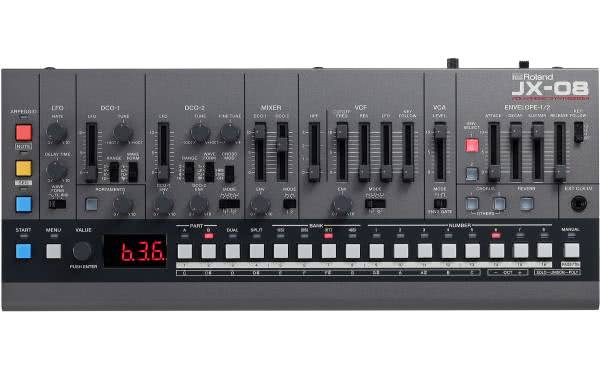
A synthesizer with the character of the eighties does not have to be large to take on a clear role in the arrangement. The Roland JX-08 brings the sound architecture of the JX-8P to the table as a compact Boutique module and combines it with direct access to the most important parameters, memory locations, and a polyphonic sequencer. JX-8P sound with direct access The sound engine is based on the Roland JX-8P from 1985. Two DCOs, high and low-pass filters, two envelopes, and cross-modulation form the basis for pads, textures, basses, and distinctive digital-analogue timbres. The controls follow the layout of the original PG-800 programmer, allowing you to implement sound changes without navigating through nested menus. 20 voices and two parts With up to 20 voices of polyphony, the module has significantly more reserves for chords and long releases compared to the original. The dual multitimbral operation works with dual and split modes; this allows you to play two patches in parallel or split them across a master keyboard. For your own sounds, there are 256 patch memories available, complemented by 32 JX-8P presets and 111 new presets. Effects for pads, leads and rhythmic sounds The effects section includes 17 types. These include three chorus variants, including the JUNO-106 chorus, delay, phaser, reverb modelled on the SDD-320, overdrive, fuzz, bit crusher, LoFi compressor, filter, and pitch shifter. Effects and filters shape the basic sound directly in the module without the need for additional equipment for initial sound ideas. Sequences with movement and external clock The integrated sequencer manages two parts, each with 64 steps and up to eight notes per step. Motion recording captures parameter movements along with the pattern, while the arpeggiator and pattern randomiser provide new rhythmic approaches. Via the external clock input, you can also synchronise the sequencer with analogue instruments or Eurorack systems. USB-C, MIDI and mobile operation USB-C transfers audio and MIDI to your computer, plus there is full-size DIN MIDI In and Out, as well as headphone, output, and mix-in jacks. The built-in mini speaker is suitable for quick checks on the go. Four AA batteries or USB-C power the module; with Ni-MH rechargeable batteries, the specified runtime for continuous operation is approximately six hours. When is the Roland JX-08 a useful addition to your setup? The Roland JX-08 is suitable for producers, keyboardists, and live acts who want to integrate characterful pads, chorused chords, or compact sequences into a MIDI setup. It can be played via a master keyboard, DAW, or hardware sequencer and takes up little space on your desk, in a rack case, or on the move. If you enjoy sound design using knobs and faders, you get a small module with an authentic JX-8P voice and extensive memory and connectivity options. Features Roland JX-08 Compact sound module with the sound and behaviour of the Roland JX-8P Two DCOs, high and low-pass filters, two envelopes and cross-modulation Up to 20 voices of polyphony and dual multitimbral operation Dual and split modes for two patches that can be used simultaneously 256 patch memories with 32 JX-8P presets and 111 new presets 17 effect types with JUNO-106 chorus, SDD-320 reverb, phaser and pitch shifter Two-part 64-step sequencer with up to eight notes per step Motion recording, arpeggiator and pattern randomiser USB-C audio/MIDI interface, MIDI In/Out and external clock input Headphone, output and mix-in jacks in mini-jack format Integrated mini speaker and power supply via USB-C or four AA batteries Compatible with the optional K-25m keyboard unit and DK-01 Boutique dock Technical specifications User memory256 sound patches | 128 patterns PolyphonyUp to 20 voices Multitimbrality2 parts | dual and split mode EffectsChorus: 3 | Delay: 4 | Overdrive | Fuzz | Drive | Bit Crusher | LoFi Comp | Phaser: 2 | Filter | Pitch Shifter: 2 Step sequencer2 parts | 64 steps | 8 notes per step and part Display7 segments | 4 characters | LED ConnectionsEXT CLOCK IN | PHONES | OUTPUT | MIX IN | MIDI IN | MIDI OUT | USB-C for audio and MIDI Power supply4 x AA Ni-MH rechargeable batteries or alkaline batteries | USB bus power Power consumption500 mA via USB Battery lifeApprox. 6 hours with Ni-MH batteries with 1,900 mAh Weight0.895 kg Dimensions (W x D x H)300 x 128 x 47 mm Scope of delivery Roland JX-08 sound module 4 x AA alkaline batteries Quick start guide Safety instructions
Average rating of 4.5 out of 5 stars
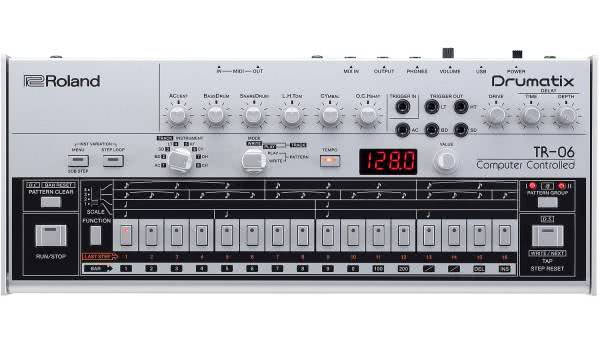
A beat with just a few instruments can develop an astonishing amount of movement if every step is perfectly placed and subtle variations are intentionally added. The Roland TR-06 adopts exactly this working method of the classic TR-606 and expands it with sound design, effects, and a significantly more versatile sequencer. TR-606 sounds with direct sound design The compact rhythm machine replicates the bass drum, snare, low tom, hi tom, cymbal, and open/closed hi-hat of the TR-606 using ACB modeling. Variations are available for the bass drum, snare, both toms, and cymbal, allowing you to tailor a pattern more closely to your desired character. Each instrument has dedicated parameters for tuning, decay, pan, and gain. This allows you to control pitch and decay directly on the unit, pan sounds in the stereo field, or increase the level for more saturation. The compressor as well as delay and drive effects can be incorporated into your pattern work. 32 steps, substeps, and probabilities The sequencer manages eight tracks and works with up to 32 steps. In total, the TR-06 saves 128 patterns across eight banks, allowing you to store different grooves, variations, and song sections directly on the device. Substeps create fast repetitions within a single step, while step loop repeats a selected range. Flam, intro/fill-in, and probability functions introduce targeted deviations into repeating sequences. Operation is handled via the 16 step buttons, the instrument selector, and the function controls on the surface. Effects for rhythm and character In addition to the compressor, delay, pan delay, tape echo, reverb, flanger, and side band filter are available. For more radical processing, there is a saturator, bit crusher, distortion, and low/high-pass filters. This allows you to add space, repetitions, or a deliberately rougher texture to individual patterns. The effect section is located directly on the control panel and is operated via drive, time, and depth. This keeps the path from the programmed pattern to the audible change short, without the need for a computer or external effects unit. Trigger, MIDI, and USB audio Five trigger outputs for accent, bass drum, snare drum, and low and high tom connect the TR-06 to modular or other trigger-capable devices. A trigger input receives external impulses. MIDI is available via 5-pin DIN and USB, allowing the rhythm machine to be integrated into hardware setups or computer-based productions. The Boutique module also transmits audio and MIDI via the micro-B USB port. A stereo output, a stereo mix-in, and a 3.5 mm headphone jack round off the connectivity. The built-in speaker helps with quick programming without the need for separate monitoring. Does the Roland TR-06 fit into your setup? The Roland TR-06 is suitable for producers who use the clear structure of the TR-606 and still want to shape their rhythms in detail. It combines familiar step input with functions for variations, fill-ins, and trigger-based expansions. The DK-01 dock can be set up at three different angles, while the metal top and compact housing support use on a desk, in a mobile setup, or alongside other Boutique equipment. Anyone who develops beats directly on the hardware gets a small rhythm center for electronic productions, live setups, and modular additions with the combination of 128 patterns, effects, and trigger outputs. Powering via USB or four AA batteries makes integration into various workspaces uncomplicated. Features Roland TR-06 Compact Roland Boutique rhythm machine with ACB modeling of the TR-606 Seven drum instruments with variations for bass drum, snare, toms, and cymbal Individual sound design with tuning, decay, pan, and gain 128 storable patterns across eight banks, each with 16 patterns 32-step sequencer with substep, step loop, flam, intro/fill-in, and probability Compressor as well as delay, reverb, flanger, filter, and drive effects Five trigger outputs and one trigger input for external devices MIDI In/Out via 5-pin DIN and audio/MIDI via USB Micro-B Stereo output, stereo mix-in, and 3.5 mm headphone jack Built-in speaker and DK-01 dock with three tilt angles Power via four AA batteries or USB bus Metal top panel in compact Roland Boutique format Technical data TypeRhythm Composer with ACB modeling of the TR-606 InstrumentsBass Drum | Snare Drum | Low Tom | Hi Tom | Cymbal | Open Hi-Hat | Closed Hi-Hat Tracks8 Pattern memory128 patterns | 8 banks with 16 patterns each SequencerUp to 32 steps | Step Loop | Substep | Flam | Intro/Fill-In | Probability EffectsCompressor | Delay | Pan Delay | Tape Echo | Reverb | Flanger | Side Band Filter | Saturator | Bit Crusher | Distortion | LPF/HPF Trigger1 x Trigger In | 5 x Trigger Out MIDIMIDI In | MIDI Out | USB-MIDI USBMicro-B | Audio and MIDI Audio connectionsStereo Output | Stereo Mix In | Stereo Phones, all 3.5 mm Power supply4 x AA batteries | USB bus Weight1.2 kg including batteries and Boutique Dock Dimensions (W x D x H)308 x 130 x 52 mm Included in delivery Roland TR-06 Rhythm Composer DK-01 Boutique Dock in silver 4 x AA alkaline batteries TR-06 owner's manual DK-01 owner's manual Safety information
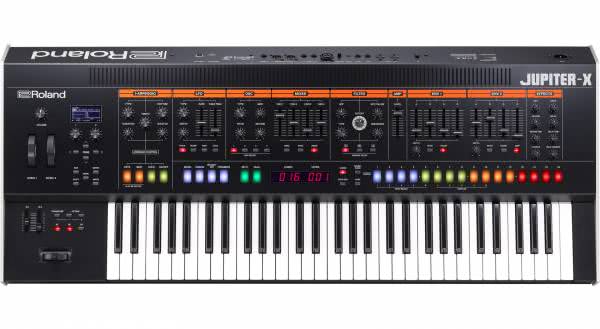
When a keyboard is meant to be a sound archive, a performance instrument, and a starting point for new arrangements all at once, direct access to the sound is essential. The Roland JUPITER-X brings together historic Roland sounds, modern ZEN-Core synthesis, and a large control interface in a 61-key synthesizer. Roland sounds in multiple synthesis forms Inside, it features ZEN-Core with MODEL Sound Generators. This provides the sonic characteristics of famous Roland instruments such as the JUPITER-8, JUNO-106, SH-101, XV-5080, and RD-Pianos; TR-808 and TR-909 drum sounds are also part of the repertoire. Your own sounds can be shaped directly on the instrument using the many knobs, faders, and buttons. The synthesizer manages at least 4,000 preset tones, 512 user tones, and at least 90 drum kits. This allows you to quickly recall familiar base sounds and then further edit them for your own productions, splits, or dense layers. Five parts for layers, splits, and rhythm The sound generation is distributed across four play parts and one rhythm part. You can, for instance, combine bass, pads, lead, and piano, and add a drum part. The 61 semi-weighted keys with channel aftertouch provide room for dynamic playing and expressive sound movements. 512 scenes save complete configurations. This is practical when a song requires multiple sound setups or when different layers need to be available in a live set without long re-programming. I-ARPEGGIO as an idea tool I-ARPEGGIO evaluates notes, rhythm, and playing style to generate matching basslines, chords, arpeggios, and drum parts. The arpeggiator works across all five parts simultaneously, so a full framework can emerge from a single played phrase. The generated patterns remain editable and can be exported to a DAW. This makes the function just as useful for song sketches as it is for performances where an arrangement is intended to develop from the playing itself. Connections, Bluetooth, and built-in speakers For the studio, balanced XLR outputs, jack main outs, MIDI In/Out, and USB computer connectivity for audio and MIDI are available. A microphone and aux input, connections for hold and control pedals, and two headphone jacks facilitate integration into different workspaces and setups. Bluetooth 4.2 supports A2DP audio and MIDI over Bluetooth Low Energy. Two built-in speaker systems with 4 W each are suitable for playing and previewing sounds directly, without the need to connect external monitors for every idea. Which setups is the Roland JUPITER-X suitable for? The Roland JUPITER-X is perfect for keyboardists and producers who want to bundle various Roland sound worlds into one instrument while still being able to dive deep into sound design. Its five parts, extensive effects section, and 61-key keyboard with aftertouch provide a solid base for electronic music, pop productions, and multi-layered performances. The direct control also proves its worth on stage: many important sound parameters are within reach without menu diving. Anyone who prepares their own scenes, adjusts layers spontaneously, and wants to create a connection between hardware synthesizer, DAW, and external equipment will find this to be a versatile working instrument. Features Roland JUPITER-X 61-key synthesizer with semi-weighted keyboard and channel aftertouch ZEN-Core sound engine with various MODEL Sound Generators Roland sound characteristics from JUPITER-8, JUNO-106, SH-101, XV-5080, and RD-Pianos Five parts with four play parts and one rhythm part At least 4,000 preset tones, 512 user tones, and at least 90 drum kits I-ARPEGGIO with playing style recognition for all five parts Four multi-effects systems with 93 types plus reverb, chorus, and delay Bluetooth audio and MIDI over Bluetooth Low Energy XLR and jack main outs, microphone input, MIDI, and USB audio/MIDI Two built-in speaker systems with 4 W each Technical data Keyboard61 semi-weighted keys with channel aftertouch Sound engineZEN-Core | various MODEL Sound Generators Parts5 | 4 Play parts | 1 Rhythm part Presetsat least 4,000 tones | at least 90 drum kits User memory512 tones | 512 scenes ArpeggiatorI-ARPEGGIO with playing recognition for 5 parts Multi-effects4 systems | 93 types BluetoothVersion 4.2 | A2DP Audio | GATT MIDI over Bluetooth Low Energy | SBC OutputsMain Out 6.3 mm jack | Main Out XLR | Headphone 3.5 mm front | Headphone 6.3 mm rear InputsMic Input 6.3 mm jack/XLR | Aux Input 3.5 mm Further connectionsHold pedal | Control pedal | MIDI In/Out | USB Computer Audio/MIDI | USB Memory Speaker amplifier2 x 4 W Power supplyAC 117-240 V | 50/60 Hz Weight16.9 kg Dimensions (W x D x H)1090 x 447 x 119 mm Included in delivery Roland JUPITER-X synthesizer Power cable Owner's manual Leaflet "USING THE UNIT SAFELY"
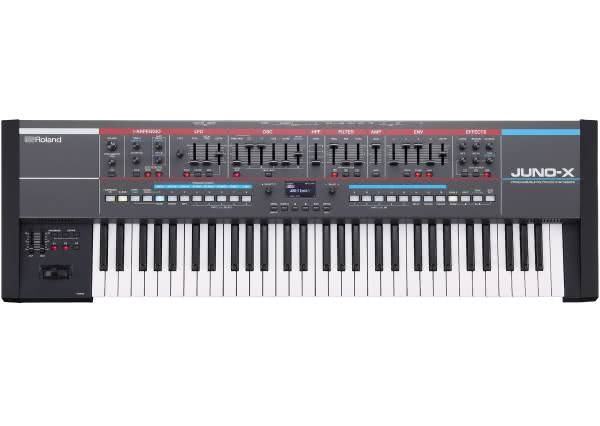
A classic synthesizer is often recognised by how quickly a useful sound idea can be created from a small movement of a knob. This is precisely where the Roland JUNO-X comes in: It combines the familiar JUNO operating logic with an extensive digital sound architecture while remaining designed for direct intervention on the instrument. JUNO sound models and ZEN-Core in the same instrument At its core, the current JUNO-X model, the recreated JUNO-60 and JUNO-106 models, and Roland's ZEN-Core system work together. This is complemented by sound material from the XV-5080, RD pianos, and a vocoder. As a result, the keyboard covers classic pads and leads just as well as piano sounds, drums, and more experimental textures. The JUNO-X model expands on the familiar character with an advanced Super Saw oscillator, velocity sensitivity, pitch envelope control, and Chorus III. The two chorus modes of the historic JUNOs are also present. Three chorus modes can be used for timbres of varying density and movement. Four Play Parts, Rhythm Part, and Scenes For more complex sounds, up to four Play Parts can be combined simultaneously or split across the keyboard. A dedicated Rhythm Part complements this structure. This allows a setup to combine, for example, a wide pad, a lead sound, a piano, and a rhythmic layer without the need for external sound sources. The 256 Scenes store the state of an entire setup. In addition to the four instrument parts and the Rhythm Part, this includes I-Arpeggio settings, effects, and other sound parameters. This is helpful for rehearsals and gigs when multiple prepared sound combinations need to be quickly accessible. Direct sound shaping on the control panel Sliders, buttons, and the clearly laid-out control panel provide a fixed place for important parameters. The LCD handles navigation through deeper settings. The 61 keys with channel aftertouch react to your touch and allow you to influence sound parameters while playing. For movement in a pattern, I-Arpeggio is available alongside a classic arpeggiator. This function generates changing note sequences based on your playing on the keyboard. The resulting MIDI performance can be exported for further work in a DAW. Effects, vocoder, and connections for studio and stage Each part can work with its own MFX and EQ processing; drive, delay, and reverb complement the sound design. Master EQ and compressor process the overall signal. Via the microphone input, a voice can be integrated and processed with the designated vocal effects or the vocoder. The rear panel offers balanced XLR and jack main outputs, a stereo audio input, MIDI In/Out, and USB Computer for audio and MIDI. A separate USB Memory port is used for backing up settings to a USB flash drive. Integrated stereo speakers and Bluetooth audio streaming make the instrument usable even without external monitoring. When is the Roland JUNO-X a suitable choice? The Roland JUNO-X is suitable for keyboardists, producers, and live musicians who want to combine the immediate access of a JUNO with a large selection of Roland sound worlds. Its part structure and Scenes fit well with setups where multiple sounds need to be ready within a song and switching needs to happen without lengthy menu navigation. In the studio, the synthesizer provides a broadly based foundation for electronic productions, pop, soundtracks, and classic keyboard parts. On stage, the velocity-sensitive keyboard with aftertouch, the stored Scenes, and the comprehensive audio and MIDI connections support an independent performance or integration into an existing hardware and DAW setup. Features Roland JUNO-X Programmable polyphonic synthesizer with ZEN-Core system JUNO-X, JUNO-60, and JUNO-106 sound models Additional sounds from XV-5080 and RD-Piano series plus vocoder Four Play Parts and a dedicated Rhythm Part 256 Scenes for complete performance setups 61 keys with velocity sensitivity and channel aftertouch JUNO chorus with three modes I-Arpeggio and classic arpeggiator Part MFX and EQ as well as drive, delay, reverb, master EQ, and compressor Microphone input with vocal effects and vocoder Integrated stereo speakers, Bluetooth audio, and Bluetooth MIDI LE USB audio/MIDI, USB memory, MIDI In/Out, and XLR and jack outputs Technical specifications Keyboard61 keys | Velocity sensitivity | Channel aftertouch Sound engineZEN-Core | JUNO-X Model | JUNO-60 Model | JUNO-106 Model Parts4 Play Parts | 1 Rhythm Part Scenes256 Presets4000 instruments | 90 drum kits | 256 user DisplayLCD | 128 x 64 px ArpeggiatorClassic arpeggiator | I-Arpeggio | 5 parts EffectsPart MFX | Part EQ | Drive | Delay | Reverb | Master EQ | Compressor BluetoothAudio | MIDI LE | Version 4.2 ConnectionsXLR main outputs | Jack main outputs | Stereo audio input | Microphone input | MIDI In/Out | USB Computer | USB Memory SpeakersIntegrated stereo system | 2x 4 W Power consumptionapprox. 20 W Weight11.6 kg Dimensions (W x D x H)1072 x 333 x 118 mm Scope of delivery Roland JUNO-X synthesizer Power supply unit Quick start guide
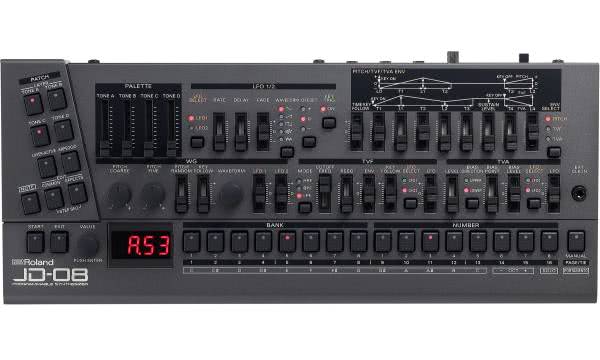
The character of a synthesiser often only emerges when individual sound layers work against each other: a moving pad under a clear attack, a narrow filter over a broad waveform. The Roland JD-08 picks up the architecture of the JD-800 precisely for this kind of direct sound shaping, bringing it into your studio or onto your desktop as a compact Boutique sound module. Four sound layers with JD-800 waveforms The sound engine works with the four-part tone structure of the JD-800. You can combine and shape four tones individually per patch, allowing you to create layered pads, punchy digital leads, or dense bass sounds from a single sound. The original's 108 waveforms are available for this purpose. 64 presets from the JD-800 are already included. Additionally, the module offers new patches and 256 memory slots for your own sounds. The interface with sliders makes the most important parameters of the sound layers immediately accessible, without the need to work your way through menu pages. Two LFOs and multi-stage envelopes For movement in the sound, each tone structure has two LFOs with sawtooth, triangle, square, random, and noise waveforms. The multi-phase, time-variable envelopes allow for progressions that change over the course of longer notes. This is particularly well-suited for sounds where you do not want the filter, volume, and pitch to remain static. The filter section provides low-pass, band-pass, and high-pass options. This allows you to specifically slim down existing waveforms, carve out resonances, or separate broad layers from each other in the mix. Effects, arpeggiator, and polyphonic sequencer The two-stage multi-effects section includes distortion, phaser, spectrum, enhancer, delay, chorus, and reverb. It is firmly integrated into the JD-08 sound concept and can be edited for every patch. Motion Recording captures parameter movements in the pattern so that a sound evolves while being sequenced. The integrated sequencer works in two parts, with 64 steps and up to eight notes per part. It stores 128 patterns; a random generator and the arpeggiator additionally provide material for sketches, basslines, and chordal figures. USB-C, MIDI, and external clock input The sound module transmits audio and MIDI to a computer via USB-C. MIDI In and Out are available for external hardware. The EXT CLOCK IN synchronises the sequencer and arpeggiator with other instruments, including modular or older analogue setups with a suitable clock signal. With up to 128-voice polyphony, depending on patch load, and two-part multitimbrality, the module remains flexible even when running multiple sound tasks simultaneously. Headphone, stereo output, and mix-in sockets complete the connections for your daily setup. Mobile Boutique module with speaker The compact housing fits beside a computer, a master keyboard, or other Boutique modules. The built-in speaker helps with quick monitoring, while USB power or four AA batteries allow operation without a separate power supply. With Ni-MH rechargeable batteries, the runtime under continuous operation is approximately six hours, depending on capacity and usage conditions. Optionally, the sound module can be complemented with the K-25m Keyboard Unit to create a small instrument. The DK-01 Boutique Dock places it in an angled position and gives the module a firm place on your desk. When is the Roland JD-08 a good addition to your setup? The Roland JD-08 is suitable for producers and keyboardists who want to use the digital character of the JD-800 with many directly accessible sound parameters. It shows its strengths with pads, complex leads, electronic basses, and evolving textures. In a desktop studio, next to a DAW, or as a MIDI sound module on a master keyboard, it brings a clearly defined tonal colour to an existing set of instruments. The combination of sequencer, arpeggiator, USB-audio/MIDI, and classic MIDI is also useful for a compact hardware setup. Battery power and the integrated speaker make it easy to capture ideas away from your fixed workspace and continue them later in a larger setup. Features Roland JD-08 Compact sound module from the Roland Boutique series with the sound architecture of the JD-800 Four-part tone structure for layered and editable sounds 108 waveforms and 64 presets from the original JD-800 256 memory slots for your own patches Two-part polyphonic 64-step sequencer with memory for 128 patterns Motion Recording, random generator, and arpeggiator for patterns and sound movements Two-stage multi-effects section with seven editable effect types USB-C Audio/MIDI, MIDI In/Out, and EXT CLOCK IN Integrated speaker as well as operation via USB or four AA batteries Compatible with Roland K-25m Keyboard Unit and DK-01 Boutique Dock Technical specifications Sound engineRoland JD-800 Modeling Waveforms108 PolyphonyUp to 128 voices, depending on patch load Multitimbrality2 parts User memory256 patches | 128 patterns EffectsDistortion | Phaser | Spectrum | Enhancer | Delay | Chorus | Reverb Sequencer2 parts | 64 steps | up to 8 notes per part Display7 segments | 4 characters | LED ConnectionsEXT CLOCK IN | PHONES | OUTPUT | MIX IN | MIDI In | MIDI Out | USB-C Power supplyUSB bus power | 4 x AA Ni-MH batteries | 4 x AA alkaline batteries Current draw500 mA via USB Battery lifeapprox. 6 hours with Ni-MH batteries at 1,900 mAh under continuous operation Weight0.84 kg including batteries Dimensions (W x D x H)300 x 128 x 49 mm Included in the box Roland JD-08 sound module 4 x AA alkaline batteries Quick Start Leaflet Safety information
Average rating of 5 out of 5 stars
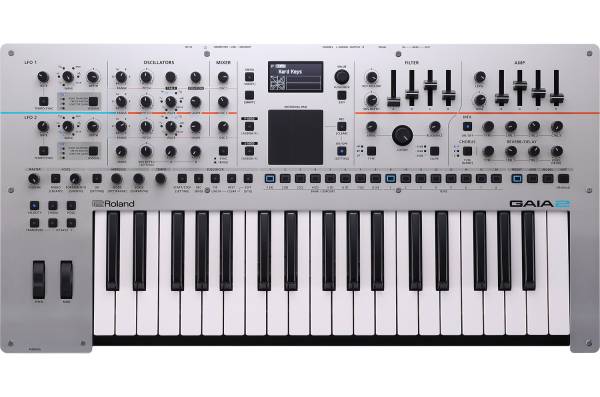
A synthesizer becomes interesting when a first tone quickly turns into a playable idea. To achieve this, the Roland GAIA 2 combines wavetable and virtual-analog synthesis with an interface where oscillators, filters, and modulation remain directly accessible. This allows for the creation of classic pads, leads, and unique digital textures without navigating through endless menus. Hybrid engine with three oscillators The sound generator utilizes one wavetable oscillator and two virtual-analog oscillators working in tandem. Wavetables can have their position changed or be crossfaded between shapes, while the other two oscillators provide familiar fundamental waves, Super Saw, and noise shapes. Phase, shape, ring, and cross modulation directly impact the harmonic structure. The multimode filter functions as a low-pass, band-pass, or high-pass with three slope settings and its own drive. Two LFOs complement the sound shaping; up to four parameters per LFO can be controlled via knobs and sliders. This keeps complex modulations accessible without separating the operation from the creative process. 37 keys and direct sound design The keyboard features 37 full-size keys, offering a different playing foundation than compact mini-keyboards. The central OLED display shows the audio waveform and recorded movements of the Motional Pad, among other information. Pitch-bend and modulation wheels are also located directly on the instrument. The GAIA 2 stores 256 preset sounds and 512 of your own tones. The maximum available polyphony is 22 voices, with the actual achievable value depending on the programmed sound and the selected Model Expansion. The factory-installed SH-101 Model Expansion complements the GAIA 2's own engine with an additional Roland sound approach. Sequencer and Motional Pad for dynamic patterns The 64-step sequencer records notes in real-time, step-by-step, or via the TR-REC method. While the pattern is running, steps can be edited; a random pattern generator provides new starting points. In addition to notes, movements of knobs, sliders, as well as the pitch and modulation wheels are recorded. The Motional Pad assigns synthesis or effect parameters to four X/Y points. Through finger movement, you switch between these states or record the movement so that a sound evolves independently. MIDI or USB synchronization binds the patterns cleanly to a drum machine, DAW, or other hardware. Effects, memory and connections For further processing, there are 53 multi-effect types available, as well as separate chorus and reverb/delay sections. These include filters, phasers, distortion, scatter, lo-fi effects, and shimmer reverb, among others. The order of the effect blocks can be adjusted, and effect parameters can, in turn, be modulated by the LFO or Motional Pad. The stereo outputs, MIDI In/Out, and the pedal connection cover the classic hardware setup. USB-C transmits audio and MIDI to computers, smartphones, or tablets and is class-compliant. Via USB-A, you can connect a USB flash drive for backups or a USB-MIDI controller; AIRA Link connects the synthesizer via USB-C to compatible Roland AIRA devices. Is the Roland GAIA 2 the right synth for you? The Roland GAIA 2 is suitable for producers, keyboardists, and live acts who want to shape sounds immediately and capture ideas directly as patterns. The three oscillators, the fixed knobs for the most important synthesis paths, and the 37 large keys bring sound design and playing feel close together. In a desktop or stage setup, the synthesizer complements a DAW, drum machine, or other MIDI hardware with audio/MIDI integration, motion recording, and an externally synchronizable sequencer. Anyone wanting to develop their own pads, basses, leads, and dynamic textures from the first sketch to the final performance will find an instrument here with clear operation logic and plenty of room for their own sounds. Features Roland GAIA 2 Digital hybrid synthesizer with wavetable and virtual-analog sound generation One wavetable oscillator and two virtual-analog oscillators 37 full-size keys for sound design and performance Direct user interface with knobs and sliders for the synthesis workflow Two LFOs with up to four freely assignable parameters per LFO Motional Pad with X/Y assignment as well as recording and playback of movements 64-step sequencer with real-time, step, and TR-REC recording 53 multi-effect types as well as separate chorus and reverb/delay sections 256 preset sounds and 512 memory slots for custom sounds Pre-installed SH-101 Model Expansion and support for further optional Model Expansions USB-C audio/MIDI, MIDI In/Out, pedal connection, and stereo outputs USB-A for USB flash storage or external USB-MIDI controllers Technical specifications Keyboard37 keys Sound engineGAIA-2 sound generator | SH-101 Model Expansion pre-installed Maximum polyphony22 voices | depending on sound settings and selected Model Expansion Preset sounds256 User sounds512 Oscillators1 x wavetable | 2 x virtual-analog EffectsMulti-effects 53 types | Reverb/delay 7 types | Chorus 3 types with 9 modes Sequencer64 steps | Real-time | Step | TR-REC | Random pattern generator ArpeggiatorUp | Down | Up & Down | Random | Note order | 16 scale variations DisplayOLED | 128 x 64 dots ConnectionsOUTPUT L/MONO | R | Headphones front and rear | Pedal | MIDI In | MIDI Out | USB-C | USB-A Power supplyAC adapter | USB bus power via USB-C Current draw600 mA with AC adapter | 1800 mA via USB bus Weight4.4 kg Dimensions (W x D x H)655 x 336 x 92 mm Included in the box Roland GAIA 2 synthesizer AC adapter PSB-5U Power cord Startup Guide Leaflet "USING THE UNIT SAFELY"
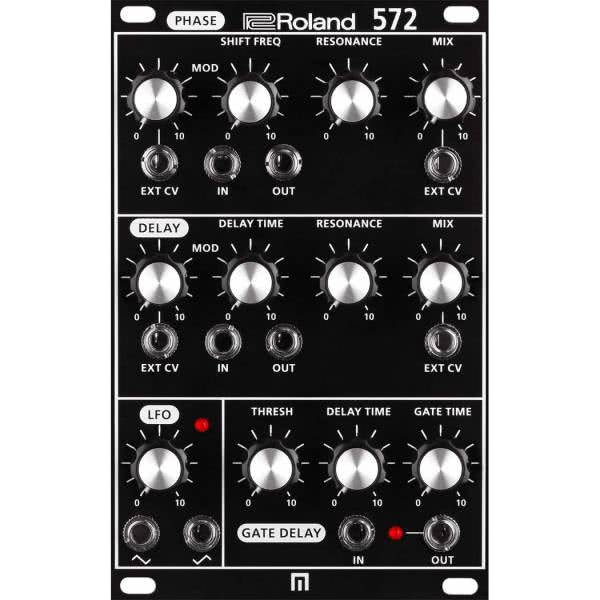
Some modulations are only noticed when they are missing: A static sound remains flat, while a phaser or a short delay brings movement to sequences, pads, and percussion. The Roland System 572 bundles four independent tools for this purpose into a fully analog 16 HP Eurorack module. Five-stage phase shifter The phase shifter operates with five stages and can be precisely adjusted via Shift Frequency and Resonance. This creates subtle phase movements as well as clearly audible, resonant colourations. The Mix control determines the amount of processed signal in the output. A dedicated modulation input is available for dynamic transitions. You can use the internal LFO or apply external CV signals. The mix can also be controlled via CV, which allows you to automate the effect level in a patch. Analog delay for short and long repetitions In the delay section, you adjust Time, Resonance or Feedback, Modulation, and Mix directly on the panel. Short times are suitable for modulated repetitions with a chorus character, while longer settings place rhythmic echoes behind the input signal. The separate Mix control makes integration into complex signal paths easy. As with the phase shifter, internal LFO modulation and external CV can influence the delay section. External CV for modulation and mix makes the module interesting when effects need to react to envelopes, sequencers, or random voltages and change continuously within a patch. LFO and gate delay in the patch The integrated LFO features a Frequency control as well as a normal and an inverted output. This provides two opposing control voltages for parallel movements in your rack. The LFO indicator displays its activity directly on the module. The gate delay processes incoming gate signals separately from the audio circuits. Threshold, Delay Time, and Gate Time determine when a signal reacts, when the output gate follows, and how long it remains active. This section is suitable for delayed triggers, offset envelopes, or rhythmic switching between other modules. How does the Roland System 572 fit into your Eurorack? The Roland System 572 fits into modular setups where effects should also become part of the control. The phase shifter and delay process audio, while the LFO and gate delay provide other modules with signals. The separate CV inputs open up many possibilities for patches whose movement changes over time. Even in a compact rack, the layout remains clear: The module requires 16 HP and combines several frequently needed effect and modulation functions. If you want to bundle analog sound processing, CV control, and gate processing in one area of your system, you get a coherent addition for sequences, drums, and pad sounds. Features Roland System 572 Fully analog Eurorack multi-effect module with 16 HP width Five-stage phase shifter with Shift Frequency, Resonance, and Mix Analog audio delay with Time, Resonance, and Mix control Internal LFO for modulation of phase shifter and delay External CV inputs for modulation and effect mix of both audio sections LFO with normal and inverted output Gate delay with Threshold, Delay Time, and Gate Time Separate inputs and outputs for phase shifter, delay, and gate delay Eurorack power supply with +12 V and -12 V Mounting screws and Eurorack power cable included Technical specifications Module typeFully analog Eurorack multi-effect module Width16 HP Phase shifterFive-stage with modulation, Shift Frequency, Resonance, and Mix DelayAnalog audio delay with modulation, Time, Resonance, and Mix LFO outputsNormal | inverted Power supplyEurorack Power consumption+12 V 110 mA | -12 V 90 mA Weight0.213 kg Dimensions (W x D x H)81 x 58 x 128.5 mm Included items Roland System 572 Eurorack module 4 Eurorack mounting screws Eurorack power cable Owner's manual Safety leaflet
Average rating of 4 out of 5 stars
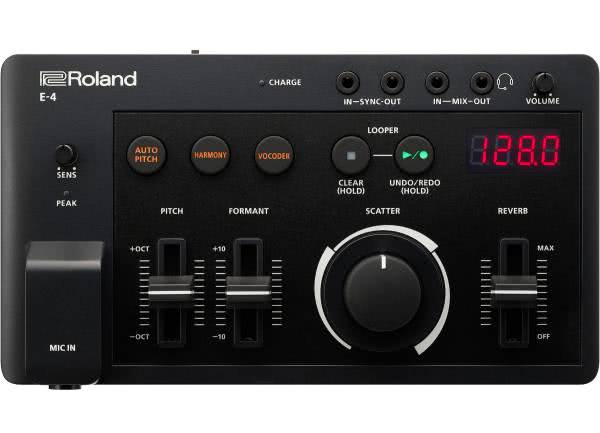
In a live set, a voice often needs to take on a different role quickly: harmony voice, robotic texture, rhythmic loop, or clearly corrected lead vocal. The Roland AIRA Compact E-4 brings these interventions to a small desktop device with direct operation and can be used for both vocals and fed-in sounds. Vocal effects right at your fingertips Auto Pitch, Harmony, and Vocoder form the core of the sound processing. With pitch and formant sliders, you can change the pitch and character of the voice independently of each other. This makes subtle corrections just as possible as distinctly artificial vocals for pop, electro, or experimental performances. Reverb, Delay, Echo, and Chorus complement the vocal processing with spatial and time-based effects. The low-cut filter and noise gate help to reduce distracting low-frequency components and background noise before further processing. Vocoder, Harmony, and external MIDI control The vocoder works with internal synth waveforms, the device's pitch functions, or an external MIDI keyboard as a control source. This allows you to play speech and vocal signals tonally and use chords specifically for vocal pads. For harmony effects, key and chord voicing can be set during performance. External MIDI control also supports pitch, harmony, and vocoder when the Voice Tweaker is integrated into a keyboard, groovebox, or DAW setup. 24-second looper and Scatter The looper records up to approximately 24 seconds of material. Unlimited overdubbing, undo/redo, and automatic BPM detection make it practical for multi-part vocal layers, short hooklines, and recurring speech or beatbox passages. Using the Scatter knob, you can break up and rhythmically process the signal directly while playing. This function is suitable for stuttering repetitions, dynamic transitions, and short interventions without the need for a computer or an additional effects processor. Connections for AIRA Compact, hardware, and computer The E-4 features Sync In/Out, Mix In/Out, MIDI In/Out, a microphone input, and USB-C. The USB-C interface functions as a class-compliant audio/MIDI interface; no separate drivers are required for connection to computers and mobile music apps. Extensive gain control is available on the 6.3 mm microphone input. The headset jack supports CTIA inline microphones. Via MIDI and Sync, the processor can be coupled with other AIRA Compact devices as well as compatible hardware. Mobile operation with battery The built-in lithium-ion battery powers the Voice Tweaker for up to approximately 3.5 hours; alternatively, it runs via USB bus power. With a weight of 290 g, the device remains light enough for small live rigs, sessions on the go, or a fixed position next to a controller, sampler, or keyboard. When is the Roland AIRA Compact E-4 a useful addition to your setup? The compact vocal processor suits singers, beatboxers, and live acts who want to incorporate their voice directly into the performance. Producers with limited space also gain a tool for vocoder layers, processed speech samples, and spontaneous loop ideas that can be integrated into existing workflows via USB-C, MIDI, and Sync. The E-4 is particularly well-suited alongside an AIRA Compact chain, a groovebox, or a MIDI keyboard. Its knobs and sliders make sound changes visible and quickly accessible, allowing vocals and fed-in signals to be shaped live without the need for nested menus. Features Roland AIRA Compact E-4 Compact vocal processor for voice and incoming audio signals Auto Pitch, Harmony, and Vocoder for vocal processing and sound shaping Pitch and formant sliders for direct modification of vocal character Reverb, Delay, Echo, and Chorus for spatial and rhythmic effects Low-cut filter and noise gate for reducing unwanted signal components 24-second looper with unlimited overdubbing, undo/redo, and BPM detection Scatter knob for real-time rhythmic sound processing Vocoder with internal synth waveforms, pitch functions, or external MIDI keyboard MIDI control for pitch, harmony, and vocoder 6.3 mm microphone input with gain control and headset jack for CTIA inline microphones Sync, Mix, and MIDI connections for integration into hardware setups Class-compliant USB-C audio/MIDI interface for computers and mobile music apps Technical data EffectsAuto Pitch | Harmony | Vocoder | Pitch | Formant | Scatter | Reverb | Delay | Echo | Chorus | Looper Maximum recording timeapprox. 24 seconds Display7-segment LED | 4 characters ConnectionsSync In/Out | Mix In/Out | Headset | MIDI In/Out | MIC IN | USB-C Microphone input6.3 mm stereo jack USBUSB-C for audio and MIDI Power supplyBuilt-in lithium-ion battery | USB bus power Battery lifeapprox. 3.5 hours Charging timeapprox. 3 hours Weight0.29 kg Dimensions (W x D x H)188 x 106.5 x 41.7 mm Included in delivery Roland AIRA Compact E-4 Voice Tweaker USB-C to USB-A cable "Read Me First" leaflet
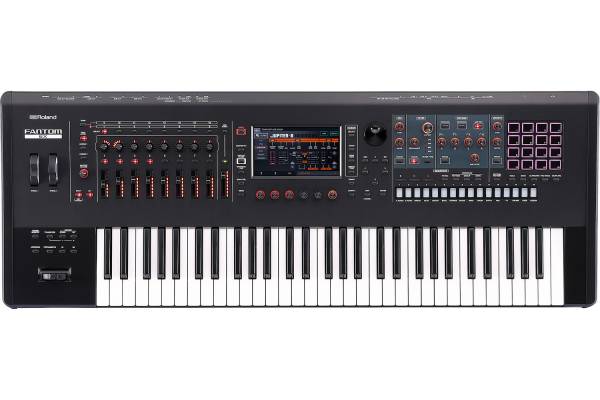
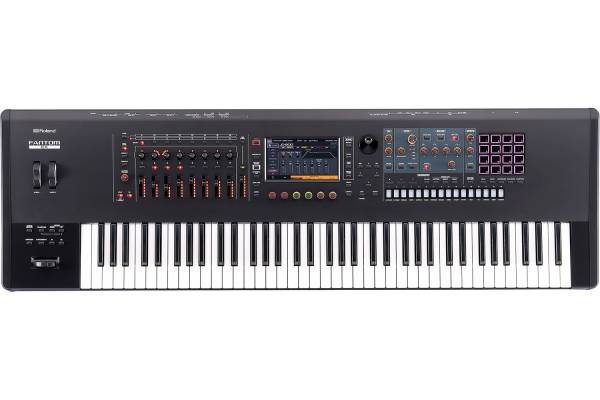
The Roland Fantom-7 EX represents the pinnacle of innovation in music production, brought together through years of research and development by the manufacturer. This workstation stands out for its intuitive user interface, inviting musicians to be creative without being hindered by technical limitations or sonic compromises. With a keyboard that offers semi-weighted synth action with aftertouch, the synthesizer provides an expressive and responsive playing experience. At the heart of the Roland Fantom-7 EX is its advanced user interface, dynamically adapting to specific tasks. This flexibility allows the user to fully focus on the creative process. Seamless integration with digital audio workstations and various plugins makes it a powerful tool for professional musicians and producers. Not only is the operation outstanding, but the sound quality is also exceptional. With multiple advanced sound engines such as ACB, ZEN-Core, and V-Piano, along with SuperNATURAL and Virtual ToneWheel, this synthesizer delivers an impressive variety of sounds. From authentically replicated acoustic instruments to extensive electronic and hybrid sounds, the Roland synthesizer provides a comprehensive range, expanding creative possibilities. The extensive internal sound library, comprising over 7,000 sounds, offers an almost limitless selection for creating unique musical pieces. Additionally, users can access additional ZEN-Core Sound Packs and Wave Expansions through Roland Cloud, further increasing the sonic diversity. Another advantage of this instrument is its extensive range of professional sequencing and sampling tools, enabling precise and flexible music production. The combination of a large color touchscreen and an ergonomically designed control panel equipped with numerous knobs, buttons, and faders ensures efficient and enjoyable operation. The Roland Fantom-7 EX is a true workstation for demanding musicians and producers who refuse to compromise on quality and flexibility. With its modern technology and comprehensive functionality, it offers everything needed for professional music production. Features Roland Fantom-7 EX Advanced workstation with no technical or sonic limitations Semi-weighted 76-key keyboard with aftertouch for dynamic playing feel Fluid workspace without confusing modes Intuitive user interface that dynamically adapts and promotes the creative process Deep integration with DAWs and plugins enabling centralized control Multiple state-of-the-art sound engines such as ACB, ZEN-Core, V-Piano, and SuperNATURAL for diverse sonic landscapes Access to a vast library of over 7,000 sounds from the renowned Roland archive Expanded possibilities through additional Sound Packs and Wave Expansions via Roland Cloud Professional sequencing and sampling tools for precise editing and flexibility Extensive effect library and enhanced mastering tools for high-quality productions Large color touchscreen complemented by a user-friendly layout with numerous knobs and faders Integration of 16 RGB pads for triggering sounds and samples Comprehensive connectivity options for diverse studio and stage applications Technical Specifications Keyboard Type: Semi-weighted with aftertouch Number of Keys: 76 Sound Engine Types: ZEN-Core, V-Piano, VTW Organ, SuperNATURAL Controllers: Pitch Bend/Modulation Lever, 2 Assignable Switches, 25 Knobs, 9 Sliders, 2 Wheels Pads: 16 Pads, 4 Banks Presets: 3500+ Tones, 90+ Drum Kits Filter Types: Analog: 3 x Low Pass, 1 x High Pass, 1 x Band Pass, 1 x Bypass Effect Types: 9 x Chorus, 7 x Reverb, Master Compressor, Master EQ Sequencer: 16-track, 16 Groups, 8 Patterns per Track, 32 Steps per Pattern Sampling Quality: Up to 24-bit / 48 kHz, WAV/AIFF, 8000 Samples, 128 Multisamples Audio Recording: Realtime, Step, TR-REC Memory: 2 GB Internal Memory Memory Expansion: USB Stick Audio Inputs: 2 x XLR-1/4" Combo (Mic/Line) Audio Outputs: 2 x 1/4" TS (L/mono, R), 2 x XLR (L, R), 4 x 1/4" TS (sub 1,2), 2 x 1/4" TS (analog filter) Headphone Output: 1 x 1/4" TRS USB Ports: 1 x Type B (Audio, MIDI), 1 x Type A (Memory), 3 x Type A (External Devices) MIDI I/O: IN, OUT, OUT/THRU, USB Pedal Inputs: 1 x 1/4" (Hold), 3 x 1/4" (Control) Additional I/Os: 2 x CV Output, 2 x Gate Output Power Source: Standard IEC AC Input Weight: 17.7 kg Dimensions (W x D x H): 1297 x 403 x 106 mm Package Contents Roland Fantom-7 EX Power Cable User Manual
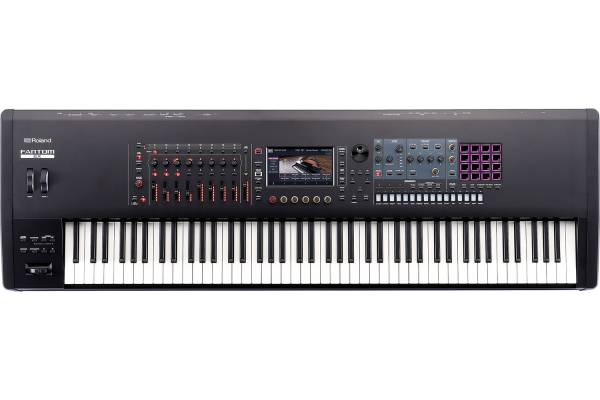
A large keyboard demands a way of working that thinks just as expansively: building sounds, preparing scenes, recording tracks, and intervening on stage without detours. The Roland Fantom-8 EX bundles these tasks into a workstation with a weighted 88-key keyboard, comprehensive sound generation, and direct access to central functions. Sound generation for piano, synthesizer and organ Several Roland sound engines operate within the instrument. ZEN-Core, V-Piano, ACB, SuperNATURAL and Virtual ToneWheel cover different tonal approaches, while more than 7,000 tones and over 90 drum kits are directly available. For sounds from Roland's history, JUPITER-8, SH-101, JX-3P and JUNO-106 ACB expansions are already included, among others. The model expansions for n/zyme, JD-800, JUNO-106, JUPITER-8, JX-8P and SH-101 are also included. The V-Piano system features the pre-installed German Concert V-Piano Expansion 01, supplemented by SuperNATURAL Acoustic Piano 3. This allows acoustic and electronic timbres to be specifically combined within a single setup. PHA-50 keyboard with channel aftertouch The 88 keys use Roland's PHA-50 wood-plastic hybrid mechanism with escapement simulation as well as ebony and ivory feel. This provides pianists with a weighted playing feel while offering the robustness of a modern workstation keyboard. Channel aftertouch expands expression after the strike. This can be used to control filter sweeps, vibrato, or other sound parameters via additional key pressure without having to remove your hands from the manual. This makes the Fantom-8 EX suitable for detailed piano parts as well as synthetic lead sounds and pads. Scenes, sequencer and sampling inside the instrument Up to 16 internal and external zones can be organised in one scene. For songs, live sets or complex keyboard rigs, sounds, external devices, and control assignments can thus be saved together and called up directly. The Scene Chain manages up to 512 scenes per chain set. The sequencer offers 16 MIDI tracks, patterns, and piano roll editing on the touchscreen. Additionally, TR-REC step sequencing, real-time and step recording, and a pad sampler are available. Keyboard multisamples support 16- or 24-bit WAV and AIFF files at 44.1 or 48 kHz. User interface for direct access A 7-inch colour touchscreen, eight knobs, eight faders, and 16 RGB pads bring key workflows to the surface. The sound modify knobs provide access to cutoff, resonance, envelope parameters, amp, and effect send, among others. This saves navigating menus when a sound needs to be adjusted during rehearsal, recording, or a performance. The pads can take over samples, notes, patterns, DAW control, or zone functions. With dedicated operating modes for Ableton Live, Logic Pro, MainStage, Cubase and Studio One, the workstation also becomes a control surface for a computer-based DAW. Integrating audio, MIDI and modular devices As a USB audio/MIDI interface, the Fantom-8 EX processes up to 16 stereo recording channels and three stereo playback channels at a maximum of 24-bit and 96 kHz. Two mic/line combo jacks, XLR main outs, jack outputs for main and sub, as well as a headphone output allow integration into studio and stage setups. For external synthesizers, MIDI In, Out 1, and Out 2/Thru are available. Two CV and two gate outputs connect the workstation with modular systems. Four pedal connections, USB for computer and storage, as well as three USB-A ports for supported external controllers, round off the connections. Is the Roland Fantom-8 EX the right workstation for your setup? This version is aimed at keyboardists, pianists, producers, and musical directors who want to use a weighted 88-key instrument as the centrepiece for stage and studio. The combination of PHA-50 mechanism, multiple sound engines, scene management, and extensive connectivity is particularly useful when piano parts, synthesizer sounds, external sound generators, and DAW projects need to converge in one instrument. Those who prepare their own performances, want to quickly shape sounds, and develop complete arrangements directly at the keyboard receive a sophisticated working environment. The combination of audio interface, MIDI control, and CV/Gate creates room for hybrid setups that range from classic keyboard rigs to modular-supplemented production workstations. Features Roland Fantom-8 EX Professional synthesizer workstation with 88 weighted hammer-action keys PHA-50 wood-plastic hybrid mechanism with escapement, ebony/ivory feel, and channel aftertouch Sound generation with ZEN-Core, V-Piano, ACB, SuperNATURAL and Virtual ToneWheel Over 7,000 tones and more than 90 drum kits on board Pre-installed ACB, Model and Piano expansions 16 zones for internal and external sound sources 16-track MIDI sequencer with piano roll and TR-REC workflow 16 RGB pads for samples, notes, patterns, zones and DAW control 16 x 3 USB audio/MIDI interface with up to 24-bit and 96 kHz MIDI, CV/Gate, audio and pedal connections for extensive setups Technical specifications Keyboard88 keys | PHA-50 wood-plastic hybrid mechanism | Escapement simulation | Channel aftertouch Sound generationZEN-Core | V-Piano | ACB | Virtual ToneWheel | SuperNATURAL | Model Sound Generators TonesOver 7,000 Drum kitsOver 90 Zones16 internal and external Display7-inch wide-VGA colour touchscreen | 800 x 480 pixels Sequencer16 MIDI tracks | 16 groups | 8 patterns per track Keyboard multisampling16/24-bit | 44.1/48 kHz | WAV/AIFF USB audioRecording up to 16 stereo channels | Playback 3 stereo channels | max. 24-bit/96 kHz Audio inputs2 x mic/line combo jack XLR/jack Audio outputsMain Out XLR L/R | Main Out jack L/Mono/R | Sub Out 1 and 2 jack L/R | Analog Filter Out 1/2 MIDIIn | Out 1 | Out 2/Thru CV/Gate2 x CV Out | 2 x Gate Out Pedal connectionsHold | Ctrl 1 | Ctrl 2 | Ctrl 3 Power supplyAC 117-240 V | 50/60 Hz Power consumption50 W Weight27.7 kg Dimensions (W x D x H)1432 x 439 x 153 mm Included in delivery Roland Fantom-8 EX synthesizer workstation Power cable Owner's manual
When you need keyboard parts ready quickly in the rehearsal room, on stage, or while songwriting, an instrument that makes sounds accessible without long menu navigation is essential. The Roland Juno-D6 combines a velocity-sensitive 61-key keyboard with the ZEN-Core sound engine and an interface that puts important controls right in front of you. Sounds for bands, production, and original ideas The sound engine works with eight ZEN-Core parts and provides more than 3,800 sounds as well as over 95 drum kits. Acoustic and electric pianos, organs, synthesizers, and other stage sounds can therefore be bundled into a Scene just as easily as multi-layered pads or rhythmic parts. For your own configurations, the keyboard can store 128 User Scenes. The 128 preset scenes are divided into two banks, and 128 favorites make frequently used sounds quickly available on the screen. With Scene Remain, a tone that is already being held continues to sustain when switching scenes. Direct access to sound and performance Four sound-modify knobs, four faders, and the pitch-bend/modulation lever allow you to shape sound parameters while playing. The colour display with 480 x 272 pixels clearly shows sound selection, creative modes, and the sequencer, without cluttering the interface with too many functions. The eight phrase pads trigger drum sounds, samples, rhythm patterns, and audio files. They can also be used to mute tracks. This allows you to specifically complement a keyboard performance with cues, transitions, or prepared audio elements. Sequencer, samples, and vocal effects An eight-track pattern sequencer captures song ideas and backing tracks directly within the instrument. Up to 64 steps are available per scene; recording is done in real-time, via step recording, or with TR-REC. An arpeggiator, chord memory, and rhythm patterns expand the musical starting point. Your own WAV samples can be imported and edited. The audio player processes WAV and AIFF files at 44.1 or 48 kHz at 8, 16, or 24 bits. For vocals, an XLR/6.3 mm combo jack is available with noise suppressor, EQ, reverb, and compressor; a 13-band mono vocoder and Auto Pitch are also integrated. Integration for stage, computer, and mobile setups Via USB-C, the keyboard works as a class-compliant audio/MIDI interface with computers and mobile devices. USB-A accepts a separately available USB stick for storage tasks. MIDI In/Out, stereo MAIN OUT, headphone output, stereo aux input, as well as connections for hold and control pedals integrate the synthesizer into various setups. The included PSB-5U power supply powers the instrument in a stationary setup. Alternatively, it can be operated via the USB-C port with USB bus power. With a weight of 5.8 kg and 61 synth-action keys, it remains easy to handle for rehearsals, sessions, and gigs with changing locations. Is the Roland Juno-D6 right for you? The Roland Juno-D6 is suitable for keyboardists who want to prepare many ready-to-play sounds, splits, and layers for live sets and need to intervene quickly while playing. The combination of scene memory, sequencer, and phrase pads also helps when writing arranged songs, as musical building blocks come together in one instrument. If you incorporate vocals, a laptop, or mobile devices into your keyboard setup, the connection options provide practical ways to do so. The compact 61-key design is particularly well-suited for musicians who want to use a lightweight performance keyboard with a versatile sound base and direct controls. Features Roland Juno-D6 Performance synthesizer with 61 velocity-sensitive synth-action keys and ZEN-Core sound engine More than 3,800 sounds and over 95 drum kits in eight ZEN-Core parts 128 User Scenes, 256 Preset Scenes, and 128 favorites Four sound-modify knobs, four faders, and pitch-bend/modulation lever for direct sound editing Eight phrase pads for samples, drum sounds, rhythm patterns, audio files, and mute functions Eight-track pattern sequencer with real-time, step, and TR-REC recording Sample import as well as WAV/AIFF audio player with 44.1/48 kHz and 8/16/24 bit Microphone input with noise suppressor, EQ, reverb, compressor, vocoder, and Auto Pitch Class-compliant USB-C audio/MIDI, MIDI In/Out, stereo MAIN OUT, and stereo aux input Power supply via power adapter or USB-C bus power Technical specifications Keyboard61 keys | velocity-sensitive | synth-action Sound engineZEN-Core | 8 parts Soundsat least 3,800 Preset drum kitsat least 95 Sequencer8 tracks per scene | maximum 64 steps Audio formatsWAV | AIFF | 44.1/48 kHz | 8/16/24 bit DisplayColor LCD | 480 x 272 pixels OutputsMAIN OUT L/MONO and R | headphones InputsMicrophone combo jack XLR/6.3 mm | stereo aux Additional connectionsMIDI In/Out | USB-A storage | USB-C audio/MIDI | hold and control pedal Power supplyPSB-5U power adapter | USB-C bus power Weight5.8 kg Dimensions (W x D x H)1005 x 324 x 94 mm Included items Roland Juno-D6 synthesizer PSB-5U AC adapter Power cord Startup Guide Safety leaflet
A 76-note keyboard provides enough space for two hands, splits, and broad chords without having to bring a full-sized stage piano into your setup. This is exactly where the Roland JUNO-D7 comes in: the lightweight synthesizer combines a velocity-sensitive synth-action keyboard with a large selection of immediately playable sounds and tools for the stage, rehearsals, and song ideas. ZEN-Core sounds for band and production The 8-part ZEN-Core sound engine provides more than 3,800 sounds and over 95 drum kits. These include acoustic and electric pianos, organs, synthesizers, strings, and other essential stage sounds. Custom scenes save your configurations and maintain the sound when switching. For additional sound capacity, ZEN-Core tones can be imported and exported. EXZ expansions are stored in the internal memory; further sound packs and wave expansions are available via Roland Cloud. You can also import, play, and edit your own WAV files. Direct access to sounds and performance functions Four sound-modify knobs, four faders, and the pitch-bend/modulation lever put essential parameters right at your fingertips without searching through menus. The colour display with 480 x 272 pixels guides you through sound selection, the sequencer, and creative modes, while eight phrase pads trigger drum sounds, samples, rhythm patterns, and audio files. The pads can also mute individual sequencer tracks. Arpeggiator and chord memory add rhythmic or harmonic accompaniment to your playing style. This makes the JUNO-D7 practical even when you need to quickly access different timbres or additional elements between song sections. Sequencer and voice in the current arrangement The integrated eight-track sequencer per scene records patterns in real-time, step-by-step, or via the TR-REC method and processes up to 64 steps. This allows you to capture backing tracks, rhythmic ideas, and short arrangements directly on the instrument without having to start a computer first. A microphone input in XLR/6.3 mm format expands the keyboard for vocals or speech. A noise suppressor, EQ, compressor, and reverb are available for this purpose. In addition, there is a 13-band vocoder as well as auto-pitch effects that integrate into electronic sound concepts and live arrangements. USB-C, audio/MIDI and classic connections Via USB-C, the instrument works as a class-compliant audio/MIDI interface for computers and mobile devices. This simplifies integration into recording, streaming, or content setups. Power can also be supplied via the USB-C port; a power adapter is included. For the rest of your setup, there is a main out in L/Mono and R, a headphone output, MIDI In/Out, a stereo mini-jack input, as well as connections for hold and control pedals. A USB-A port accommodates a separately available USB flash drive for data storage. Which setups is the Roland JUNO-D7 suitable for? The Roland JUNO-D7 is suitable for keyboardists in bands who want a portable instrument with 76 keys and a vast sound library for rehearsals and performances. The additional key range helps with piano parts, split keyboard zones, and two-handed pads, while sounds, scenes, and controls remain quickly accessible during live flow. For musicians who want to sketch ideas without a computer or integrate vocals, samples, and sequences into a keyboard setup, the instrument offers a coherent workspace. At 6.8 kg, it remains easy to transport and can be used flexibly with mobile devices or a mobile power source via USB-C. Features Roland JUNO-D7 Lightweight synthesizer with 76 velocity-sensitive synth-action keys ZEN-Core sound engine with eight parts More than 3,800 sounds and over 95 drum kits EXZ expansions as well as import and export of ZEN-Core tones Import and editing of custom WAV files Eight phrase pads for sounds, samples, patterns, audio files, and track mute Eight-track step sequencer with up to 64 steps Microphone input with noise suppressor, EQ, compressor, reverb, vocoder, and auto-pitch Class-compliant USB-C audio/MIDI for computers and mobile devices USB-C bus power for mobile setups Technical specifications Keyboard76 velocity-sensitive synth-action keys Sound engineZEN-Core | 8 parts SoundsMore than 3,800 Preset drum kitsMore than 95 Sequencer8 tracks per scene | up to 64 steps | real-time, step, TR-REC Audio file formatsWAV | AIFF | 44.1/48 kHz | 8/16/24 bit DisplayColour LCD | 480 x 272 pixels OutputsMain Out L/Mono and R on 6.3 mm TRS | Headphone on 6.3 mm stereo jack InputsMicrophone on XLR/6.3 mm jack | external input on stereo mini-jack ConnectionsMIDI In/Out | hold/control pedal | USB-A for storage | USB-C for computer and power Power supplyPower adapter | USB-C bus power Weight6.8 kg Dimensions (W x D x H)1217 x 324 x 94 mm Included in delivery Roland JUNO-D7 synthesizer PSB-5U power adapter Power cord Startup Guide Safety information
A musical idea does not have to find its way through several devices first. When sounds, sequences, samples and external instruments converge on one instrument, the focus remains on arrangement and performance. The Roland Fantom-6 EX bundles these workflows into a 61-key workstation with synth-action and channel aftertouch. Sound engines and EX expansions The workstation combines ZEN-Core, V-Piano and SuperNATURAL with the Virtual ToneWheel organ. Numerous ZEN-Core tones as well as model expansions are available for electronic sounds. The EX package complements the original FANTOM with ACB models of the JUPITER-8, SH-101, JX-3P and JUNO-106 as well as the n/zyme and JD-800 model expansions. Two additional grand piano sounds expand the piano range of the EX equipment. The sound sources can be organised into 16 internal and external zones. This allows you to prepare, for example, a multi-part keyboard sound with software instruments, external MIDI equipment and your own samples within one Scene. Scenes, sequencer and sampling Scenes save sounds, patterns and the control layout as a recallable working environment. They can be arranged in a chain and switched without an audible gap. This is practical when a set includes different song parts, layers or external devices and you do not want to reconfigure the assignment every time you switch. The internal sequencer works with 16 MIDI tracks, real-time recording, step recording and TR-REC. In addition, there is piano roll editing on the touchscreen and a clip-oriented grid. The 16 RGB pads trigger sounds, samples, clips and other functions; up to 8,000 samples and 128 multisamples are available for keyboard multisamples. Direct access to sound and performance The 7-inch colour touchscreen, eight knobs, eight faders and other controls give important parameters a fixed place on the panel. In the synthesiser section, oscillators, filters and envelopes can be edited immediately. A stereo analogue filter supplements the digital sound generation with LPF, HPF and BPF characteristics. A pitch bend/modulation lever, two wheels, assignable switches and pedal inputs are available for playing. The keyboard's channel aftertouch can control expression and sound development while playing. You can also integrate matching Roland controllers via the three USB ports for external devices. Audio, MIDI and modular instruments The connection section connects the workstation to your studio, stage and computer. In addition to balanced XLR and jack main outputs, there are four sub-outs, two mic/line combo jacks and separate analogue outputs. As a USB audio interface, the instrument transmits up to 16 stereo channels to the computer and three stereo channels back. MIDI In, Out 1 and Out 2/Thru allow for the integration of classic hardware. Two CV and two gate outputs control analogue or modular synthesisers. Your own sounds, patterns and external instruments can thus come together in a scene, while the operation remains on the keyboard. Is the Roland Fantom-6 EX the right workstation for your setup? The Roland Fantom-6 EX is suitable for keyboardists, producers and live acts who want to bring together many sound sources on a central performance and production interface. Its 61 semi-weighted keys are suitable for synthesiser parts, piano layers and studio work, while scenes, pads and the sequencer support a prepared live flow. The workstation also offers clear advantages for setups with software instruments, MIDI hardware or CV/gate-capable sound generators. You can organise sounds and control data together, transfer audio via USB and save recurring configurations as a Scene. The EX expansions give electronic sound design additional historical Roland models and modern digital timbres. Features Roland Fantom-6 EX 61-key synth-action keyboard with channel aftertouch EX equipment with ACB models of JUPITER-8, SH-101, JX-3P and JUNO-106 n/zyme and JD-800 model expansions as well as two additional grand piano sounds ZEN-Core, V-Piano, SuperNATURAL and Virtual ToneWheel as sound sources 16 zones for internal and external parts 16-track sequencer with real-time, step and TR-REC recording 16 RGB pads for sounds, samples, clips and control functions 7-inch colour touchscreen with 800 x 480 pixels Stereo analogue filter and extensive effect section USB audio/MIDI, MIDI, CV/gate as well as extensive audio connections Technical data Keyboard61 semi-weighted keys with channel aftertouch Sound sourcesZEN-Core | V-Piano | Virtual ToneWheel | SuperNATURAL Acoustic Zones16 internal and external zones Display7-inch colour touchscreen | 800 x 480 pixels Sequencer16 MIDI tracks | Real-time recording | Step recording | TR-REC Keyboard multisampling8,000 samples | 128 multisamples | WAV/AIFF with 16/24 bit and 44.1/48 kHz Effects16 multi-effect systems | 90 types | 9 chorus types | 7 reverb types Audio interfacemaximum 24 bit/96 kHz | 16 stereo channels recording | 3 stereo channels playback ConnectionsXLR and jack main outputs | 4 sub-outs | 2 mic/line combo jacks | MIDI In/Out 1/Out 2/Thru | 2 CV out | 2 gate out Power supplyAC 117–240 V | 50/60 Hz Weight15.3 kg Dimensions (W x D x H)1084 x 403 x 106 mm Scope of delivery Roland Fantom-6 EX synthesiser workstation Power cord Owner's manual
New sounds do not have to find their way into the instrument via a computer. When a compatible synthesizer communicates directly with a mobile device, browsing the Roland Cloud becomes a part of your own sound design. The Roland WC-1 Wireless Adapter establishes exactly this connection for selected Roland keyboards. Wireless access to Roland Cloud The adapter works with the Roland Cloud Connect app on a compatible smartphone or tablet. Through this, you can select, audition, and install suitable content for the connected instrument. A computer is not required for this, because the mobile device handles the connection between the keyboard and the Roland Cloud. The WC-1 is not a sound generator itself and does not replace a remote control for the synthesizer. Its purpose lies clearly in providing wireless access to expansions and sound content intended for the respective instrument. Select Sound Packs and expansions directly Via the app, you can choose from Sound Packs, Wave Expansions, and Model Expansions, provided they are compatible with the keyboard you are using. You can audition sounds first and then load them into the instrument. This is practical if you want to expand your sound repertoire in a targeted way or compare different expansions before installing them. Included with the adapter is one year of access to Roland Cloud Ultimate. After this period, a suitable membership is required for continued access to the corresponding Cloud content. Compatibility with JUPITER-X, JUPITER-Xm and JUNO-X The Wireless Adapter is intended for the Roland JUPITER-X, JUPITER-Xm, and JUNO-X. It does not function as a universal Bluetooth adapter for any Roland instrument. Therefore, before purchasing, you should ensure that one of these three compatible keyboards is used in your setup. The Roland Cloud Connect app is available for iOS, iPadOS, and Android. This way, a mobile device can serve as a connection point without the synthesizer having to be tied to a fixed computer location for loading content. Who is the Roland WC-1 Wireless Adapter suitable for? The Roland WC-1 Wireless Adapter is perfect for owners of a JUPITER-X, JUPITER-Xm, or JUNO-X who wish to select Roland Cloud expansions conveniently via a mobile device. It supports musicians and sound designers who want to keep their instrument up to date with new sounds and compatible expansions and want to audition content directly before loading. The wireless connection is also helpful for keyboardists preparing multiple tones for rehearsals, productions, or live setups. The adapter brings access to the relevant Roland Cloud library exactly where the instrument is currently located. Features Roland WC-1 Wireless Adapter Wireless adapter for accessing the Roland Cloud via a compatible mobile device Intended for Roland JUPITER-X, JUPITER-Xm and JUNO-X Connection via the Roland Cloud Connect app Select and install Sound Packs, Wave Expansions, and Model Expansions Audition compatible content before loading One year of access to Roland Cloud Ultimate included App support for iOS, iPadOS, and Android No computer required for connection and content transfer Technical specifications Product typeWireless adapter for Roland Cloud Connect Compatible instrumentsRoland JUPITER-X | Roland JUPITER-Xm | Roland JUNO-X Compatible mobile platformsiOS | iPadOS | Android Supported contentSound Packs | Wave Expansions | Model Expansions
An 88-key stage keyboard must feel like an instrument under your hands while still working without a complex additional setup. This is exactly what the Roland Juno-D8 achieves by combining a weighted PHA-4 Standard keyboard with a large ZEN-Core sound library, intuitive operation, and a chassis that remains easily portable at 14.5 kg. Weighted 88 keys for piano parts and synth pads The PHA-4 Standard keyboard with Ivory Feel and escapement brings the resistance of a hammer action to a versatile performance keyboard. This allows for nuanced piano playing, while the full number of keys provides enough space even for two-handed playing, wide chords, and split setups. The Juno-D8 is not limited to a single sound character. The ZEN-Core sound engine provides more than 3,800 sounds and over 95 drum kits, including acoustic and electric pianos, organs, synthesizers, and rhythmic sounds. 128 Favorite slots help you find frequently used sounds quickly. Scenes, knobs, and pads for live performance Sounds can be organised into Scenes and called up directly for songs or setlists. There are 256 preset Scenes and 128 user Scenes available. The Scene Remain function maintains the previous sound when switching, so pads or held notes do not cut off abruptly. Four sound modify knobs, four faders, and eight pads provide dedicated controls for important parameters and performance functions. The pitch bend/modulation lever adds typical synthesizer gestures to your playing without you having to work your way through menu pages. Sequences, samples, and sound editing The integrated step sequencer works with eight tracks and up to 64 steps per Scene. Ideas can be recorded in real-time, step-by-step, or via TR-REC and subsequently edited. Rhythm patterns, arpeggiator, and chord memory support the development of accompaniments directly on the keyboard. You can also trigger WAV and AIFF files from USB flash memory using the pads. Multi-effects, part EQs, drum compressors, chorus, and reverb are available for sound shaping. A 13-band vocoder adds another sonic dimension to the microphone input. Connections for band, stage, and computer The outputs are provided as L/MONO and R jacks in 6.3 mm TRS format, complemented by a headphone output, MIDI In/Out, an external stereo input, and connections for hold and control pedals. A microphone can be connected via XLR or 6.3 mm jack, for example for vocoder parts or announcements. The USB-C computer connection transmits audio and MIDI. The keyboard can also be powered via USB bus power through this connection. USB Type-A is used to connect a separately available flash drive for sounds, expansions, and audio files. Who is the Roland Juno-D8 suitable for? The Roland Juno-D8 suits keyboardists looking for a weighted 88-key keyboard with many instantly available sounds for rehearsals, performances, and songwriting. Piano players get an expressive foundation, while bands and solo artists can integrate scenes, pads, sequencer, and the versatile connections into a compact live setup. The instrument also offers a coherent workspace for producers who want to capture musical sketches without a computer and transfer them to a DAW later via USB-C. The sound library, user interface, and expandability via Roland Cloud can be tailored to your own musical practice. Features Roland Juno-D8 Performance synthesizer with 88 weighted keys and PHA-4 Standard keyboard ZEN-Core sound engine with more than 3,800 sounds and over 95 drum kits 256 preset Scenes and 128 user Scenes with Scene Remain Eight-track step sequencer with up to 64 steps per Scene Eight performance pads, four sound modify knobs, and four faders WAV and AIFF audio player for files with 44.1 or 48 kHz Multi-effects, part EQ, compressors, chorus, reverb, and 13-band vocoder Arpeggiator, chord memory, rhythm patterns, and DAW control XLR/6.3 mm microphone input, stereo outputs, MIDI, and pedal connections USB-C for audio, MIDI, and USB bus power Technical specifications Keyboard88 keys | PHA-4 Standard keyboard with escapement and Ivory Feel Sound engineZEN-Core Parts8 Presetsmore than 3,800 Preset drum kitsmore than 95 Step sequencer8 tracks | maximum 64 steps per Scene Audio formatsWAV | AIFF | 44.1/48 kHz | 8/16/24 bit Displaygraphic colour LCD | 480 x 272 pixels | backlit OutputsMAIN OUT L/MONO and R | 6.3 mm TRS Microphone inputXLR | 6.3 mm jack USBType-A for storage | Type-C for computer, audio, and MIDI Power supplyAC adapter | USB bus power via USB-C Weight14.5 kg Dimensions (W x D x H)1393 x 355 x 138 mm Included in delivery Roland Juno-D8 synthesizer PSB-5U AC adapter Power cord Quick Start guide Leaflet "USING THE UNIT SAFELY"
Average rating of 5 out of 5 stars
A synthesizer can capture an idea before it disappears into the arrangement. Small steps, a changed filter setting, or a played chord are often enough for a new loop. The Roland Aira Compact S-1 Tweak Synth brings this direct access to sound generation and sequencing into a compact format with a battery. SH-101 sound foundation with four voices The sound engine is based on the Roland SH-101 and works with Analog Circuit Behavior (ACB). Square, saw, sub, and noise oscillators form the basis for basses, leads, pads, and rhythmic sounds. Using the controls for the oscillator, filter, envelope, and LFO, you shape the sound directly on the device. In addition to monophonic playing, Poly, Unison, and Chord modes are available. The four-voice polyphony expands the classic approach with chords and denser sequences. 26 multi-functional pads serve as a keyboard over more than two octaves and simultaneously as an input surface for further functions. Draw and dismantle waveforms The S-1 goes beyond the familiar SH-101 structures in oscillator editing. With OSC Draw, you can draw your own waveforms on the step pads. OSC Chop divides waveforms into sections, creating more metallic, complex timbres. A separate riser based on the noise oscillator adds transitions, sweeps, and pulsating effects. Chorus algorithms from JUNO and JX-3P synthesizers, delay, and reverb are available for further processing. Knobs for the effects keep these adjustments quickly accessible during performance. 64 steps for patterns and variations The built-in sequencer stores 64 patterns with up to 64 steps. Notes can be recorded live via the pads or set and changed precisely in step mode. Motion recording records knob movements and makes repeated sound changes within a pattern reproducible. Probability, sub steps, velocity, shuffle, and portamento help make loops less static. For live playing, an arpeggiator, step loop, and pattern transposition are added. D-Motion uses device movements to control parameters such as pitch or modulation. Audio, MIDI and synchronization in a compact setup Via USB-C, the synthesizer functions as an audio and MIDI interface with a computer or mobile music apps. MIDI In and Out, Sync In and Out, as well as MIX In and MIX Out/Phones connect it to other instruments, a clock source, or a small live setup. As a standalone sound generator, it can also be integrated into a larger MIDI rig. The internal lithium-ion battery provides up to 4.5 hours of runtime and is charged via USB. Measuring 188 x 106 x 36.2 mm and weighing 0.305 kg, the instrument fits into small bags and remains quickly accessible for sketches, sessions, and spontaneous jam ideas. Is the Roland Aira Compact S-1 Tweak Synth the right synthesizer for you? The Roland Aira Compact S-1 Tweak Synth is right for you if you are looking for a compact synthesizer for immediate sound design and pattern work. Its combination of an SH-101-inspired foundation, four voices, and deep waveform tools appeals to musicians who want to combine classic synthesizer sounds with their own textures. The format is also practical for mobile setups with a groovebox, laptop, or other AIRA Compact devices. The pads, the sequencer, and the connection options give you a handy workspace for melodies, basslines, chord progressions, and lively loops that can be further developed while the track is running. Features Roland Aira Compact S-1 Tweak Synth Compact four-voice tweak synthesizer with ACB sound engine based on the Roland SH-101 Oscillators with square, saw, sub, and noise as well as mono, poly, unison, and chord modes OSC Draw for drawing your own waveforms on the pads OSC Chop for editing waveforms in sections 64-step sequencer with 64 patterns, motion recording, probability, and sub steps Arpeggiator, step loop, pattern transposition, and D-Motion for performance Chorus, delay, and reverb with directly accessible effect controls USB-C audio/MIDI, MIDI In/Out, sync In/Out as well as MIX In and MIX Out/phones Technical data Polyphony4 voices User patterns64 SequencerUp to 64 steps per pattern EffectsChorus | Delay | Reverb Display4-digit 7-segment LED display USBUSB-C for audio | MIDI | battery charging Audio connectionsMIX In | MIX Out/phones, each 3.5 mm stereo mini jack MIDI connectionsMIDI In | MIDI Out, each 3.5 mm stereo mini jack Sync connectionsSync In | Sync Out, each 3.5 mm mini jack Power supplyIntegrated lithium-ion battery | charging via USB-C Battery lifeUp to 4.5 hours Charging timeApprox. 3 hours Power consumption500 mA Weight0.305 kg Dimensions (W x D x H)188 x 106 x 36.2 mm Included in delivery Roland Aira Compact S-1 Tweak Synth USB-C to USB-A cable Safety and warranty information
Roland Synthesizer
Roland synthesizers cover an unusually broad field: compact desktop devices for a small workspace, classic keyboard synthesizers, high-performance workstations, and a keytar for the stage. Therefore, the selection process does not start with a specific tone color, but with the question of how you want to play and use the instrument. Are you looking for a direct entry into sound synthesis, a versatile production keyboard, or a device that primarily delivers quickly accessible sounds for live use?
The product range includes, among others, compact devices from the AIRA Compact and Boutique worlds, modern synthesizers like the GAIA 2 and SH-4D, as well as larger JUNO, JUPITER, and FANTOM models. The product groups differ significantly in terms of keyboard, sound generation, operation, and integration into your setup. If you would like to compare across brands first, the overarching category Synthesizer provides further guidance.
Topic overview
- Which Roland synthesizers are suitable for which application?
- Sound generation: Vintage character, ZEN-Core, and modern engines
- Correctly classifying keyboard, polyphony, and multitimbrality
- Connections and software: What needs to fit into your setup?
- Avoiding typical bad buys
- How to make your selection
- Frequently asked questions about Roland synthesizers
Which Roland synthesizers are suitable for which application?
A compact desktop synthesizer or a small AIRA Compact device fits well if space is limited, if you create sounds alongside a DAW, or if you are planning a mobile setup. Such devices do not replace a large keyboard, but can be played via MIDI and are quick to set up. Control interface and size are more decisive here than the longest possible list of features: anyone who wants to tweak settings directly on the device should compare knobs, displays, and menu structures carefully.
Keyboard synthesizers like the GAIA 2, Juno-X, or Jupiter-Xm are aimed at players who want to shape sounds immediately via keys, pitch bend, and performance controllers. The GAIA 2 combines wavetable and virtual-analog sound generation, while the larger JUNO and JUPITER models bring together various Roland sound worlds, layers, and performance memories. Multiple simultaneously usable parts are particularly important when splits, pads beneath a lead sound, or prepared live sets are required.
FANTOM models lean even more towards the workstation category. They make sense if you want to bundle extensive sound libraries, multiple zones, sequencing, and the integration of further hardware or software into a central keyboard. A device of this class is not automatically worthwhile for everyone: for individual bass, lead, or pad sounds, a smaller synthesizer is often faster to master and significantly easier to transport.
The AX-Edge takes on a special role. The keytar is played with a strap and is intended for dynamic stage performances, not as a replacement for a classic studio keyboard. Anyone looking for such an instrument should check the playing position, power supply, and connection to the stage setup in addition to the sound palette. For pure production at a desk, a normal keyboard is usually the more suitable choice.
Sound generation: Vintage character, ZEN-Core, and modern engines
Roland often combines current technology with familiar sound families from its own history. Boutique models, for example, draw on Roland classics like the Juno, JX, JD, or TR and bring their operating concept into a compact format. This is interesting if you are looking for a specific character and do not need a large workstation. However, the small devices have less space for controls and keys, which becomes relevant for in-depth sound design or playing with both hands.
ZEN-Core plays an important role in many current Roland keyboards. This is a common sound platform upon which different instrument types and sound content can be built. In practice, this means: a device can manage PCM-based instruments, drums, or other sound models alongside synthesizer sounds. However, the extent to which sounds and expansions can be exchanged between individual devices depends on the respective model and its software version. Therefore, always check compatibility for the specific device.
Some instruments supplement their internal engine with Model Expansions. These replicate certain older Roland synthesizers as independent sound models. The GAIA 2, for example, includes an SH-101 model; further expansions may be available via Roland Cloud. This broadens the selection, but is not a reason to base your purchasing decision on this alone: the available sound generation and operation must fit your working style even without additional content.
| Device type | Typical use | What you should look for |
|---|---|---|
| Compact desktop or Boutique synthesizer | Additional sounds, mobile workspace, MIDI setup | Control access, external keyboard, audio and MIDI connections |
| Keyboard synthesizer | Sound design, rehearsals, live playing, and production | Keyboard size, polyphony, layers, and storable performances |
| Workstation | Central hub for complex productions and live sets | Zones, sequencer, audio integration, and transport weight |
| Keytar | Live performance with freedom of movement | Playing feel while standing, power supply, and stage signals |
Correctly classifying keyboard, polyphony, and multitimbrality
The number of keys determines how comfortably you play. 37 keys are enough for leads, basses, and compact setups; for two-handed chords, wide splits, or classic keyboard playing, 61 keys or more are more comfortable. The features of the keyboard are also decisive: velocity, aftertouch, and performance controllers give you access to dynamics and modulation without having to change every sound parameter via menus or knobs.
Polyphony describes how many voices a device can generate simultaneously. It quickly runs short if you play long release times, layer multiple sounds, or use complex chords. Multitimbrality goes one step further: it refers to separately controllable parts with different sounds. This is helpful for splits, external MIDI tracks, or a live set in which multiple instrument roles are meant to come from one keyboard.
The filters in this category help to narrow down the selection by number of keys, sound generation, MIDI inputs and outputs, polyphony, multitimbrality, and integrated sequencer. Use them in this order: first determine the form factor and keyboard, then compare sound architecture and performance functions. An integrated sequencer is practical for sketches without a computer or for hardware jams, but is not a must if your DAW is already the center of your setup.
Connections and software: What needs to fit into your setup?
For most setups, audio outputs as well as MIDI via DIN and/or USB are crucial. Depending on the model, USB can transmit MIDI data, audio, or both. For a DAW connection, a USB audio interface inside the synthesizer saves additional cabling, while classic MIDI jacks remain very useful for older hardware, multiple devices, or a MIDI interface. The number and type of outputs become important if you want to record sounds separately or mix them individually on stage.
An audio input, microphone input, or CV/Gate connections are not standard equipment for every Roland series. They expand certain models to include external sounds, vocoder functions, or connections to modular hardware. For a classic keyboard setup, stereo output and MIDI are often sufficient. If, however, you want to combine devices with a groovebox, a Eurorack system, or multiple hardware synthesizers, you should carefully check the connection list against your existing equipment before purchasing.
Roland Cloud is a software and content offering centered around additional sound content, instruments, and, for supported hardware models, Model Expansions. It is not necessary to use a synthesizer in principle. It becomes relevant if you want to specifically load extensions or manage sound libraries. Ongoing offers, prices, and available content can change; therefore, for your purchasing decision, count on the functions available out of the box first.
Avoiding typical bad buys
- Buying a mini or desktop device even though you play with two hands regularly and need a full-sized keyboard.
- Choosing high polyphony without checking if the device actually supports the required layers, splits, or MIDI parts.
- Equating USB-MIDI with USB-Audio. Not every device performs both tasks.
- Planning additional sound models without checking beforehand whether they are available and useful for the desired model.
- Considering weight, power supply, audio outputs, and the time required to save and recall performances too late for a live set.
How to make your selection
For a direct entry into sound design, a device with easily accessible knobs and a manageable architecture is usually more sensible than a huge sound library. If you primarily play and need to reliably recall different sounds on stage, the keyboard, scenes or performances, split and layer functions, and the outputs take center stage. For production with hardware samplers or rhythmic patterns, a look at the sampler category can be useful because MIDI synchronization and separate tracks shape the overall setup more than a single synthesizer.
The Roland brand stands for very different working methods in this category, from small digital replicas of historical devices to modern, multi-part sound platforms. Therefore, do not decide based on the well-known model name alone. The right operation, keyboard, and integration bring you more in everyday life than features that only look good on a data sheet. A broader overview of the product range is also offered by the Roland brand overview.
Frequently asked questions about Roland synthesizers
Is a Roland Juno suitable for beginners?
That depends on the model and your goal. A Juno with a clear interface and good access to the most important sound parameters can offer a comprehensible entry point. Larger Juno models additionally bring layers, multiple engines, and extensive memory functions. This is flexible, but not automatically simpler than a smaller synthesizer with fewer options.
What is a keytar?
A keytar is a portable synthesizer with a keyboard that is played with a strap like a guitar. It is suitable for stage performances with freedom of movement. Sonically and technically, it can be a fully-fledged instrument, but the playing posture and intended use differ significantly from a keyboard on a stand.
Do I need Roland Cloud to use a Roland synthesizer?
No. The hardware works independently with its built-in sounds and functions. Roland Cloud becomes interesting if you want to use additional sound packs or Model Expansions on compatible models.
When does an integrated sequencer make sense?
A sequencer makes sense if you want to capture ideas without a computer, synchronize patterns with other hardware, or build a compact live setup. If you work almost exclusively in a DAW, a good MIDI and audio workflow is often more important than an extensive internal sequencer.